


The most significant investment you’ll ever make in your home isn’t the aesthetic finish, but the invisible layers that define its comfort and longevity. If you find yourself asking, how do I pay for retrofit – a guide for homeowners like this one is the essential resource you need to navigate a landscape of shifting government schemes and complex financial products. It’s perfectly natural to feel a sense of hesitation when faced with the intricacies of grant eligibility or the fear of an investment misspent on substandard workmanship.
We believe that your home is more than a building; it’s a deeply personal refuge and an expression of your identity. You deserve a clear, sophisticated roadmap that honours both your vision and your capital. This article promises to illuminate the multifaceted financial pathways available to you, from the substantial £7,500 Boiler Upgrade Scheme grants to the innovative 0% green financing products currently offered by leading lenders. By understanding how professional PAS 2035 assessments protect your investment, you can move forward with the quiet confidence that your journey towards a more refined, energy-efficient lifestyle is built on a foundation of security and excellence.
Key Takeaways
- Reframe your energy transformation as a curated investment in your home’s sanctuary, focusing on the ‘Fabric First’ philosophy to protect your capital and enhance enduring value.
- Discover the answer to “How do I pay for retrofit – a guide for homeowners” by exploring the latest public funding, including the £7,500 Boiler Upgrade Scheme and the comprehensive Warm Homes Plan.
- Navigate the world of sophisticated private financing, from innovative zero-percent green borrowing to mortgage rewards that favour energy-efficient properties with high EPC ratings.
- Learn how to implement a strategic, phased roadmap that allows you to prioritise improvements for immediate comfort whilst working towards a harmonious whole-house vision.
- Understand the vital role of professional oversight in safeguarding your investment, ensuring every detail of your project meets the rigorous PAS 2035 standards for quality and performance.
The Philosophy of Retrofit Investment: Beyond the Initial Cost
A home is a curated collection of moments; a personal refuge that reflects the history and aspirations of those within its walls. When you begin to ask, how do I pay for retrofit – a guide for homeowners should offer more than a simple list of expenses. It should provide a philosophy of value. Viewing your home’s energy transformation as a transformative journey allows you to look beyond the immediate invoice and see a long-term enhancement of your sanctuary’s enduring quality. It’s about moving away from the idea of fixing a problem and towards the art of curating an environment that resonates on a personal level.
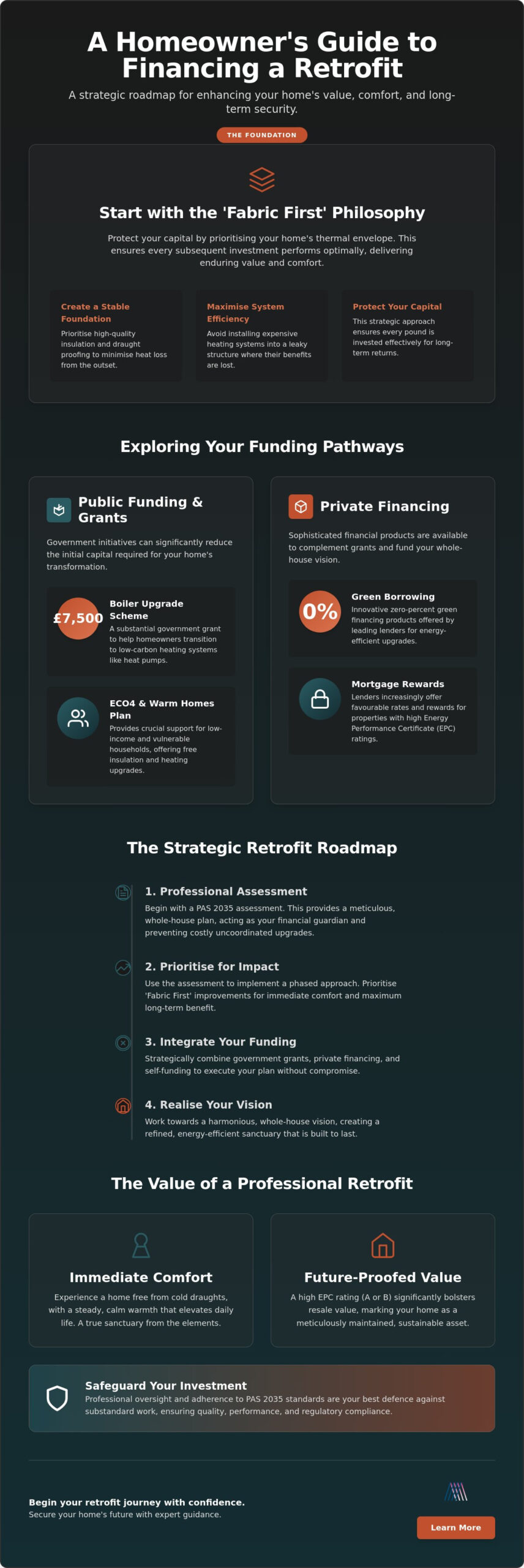
The ‘Fabric First’ philosophy is the cornerstone of this approach. It’s a strategy for capital protection that ensures every pound you invest is utilised effectively. By prioritising the building’s envelope, including high-quality insulation and draught proofing, you create a stable thermal foundation. This prevents the common mistake of installing expensive heating systems into a leaky structure. Whilst many homeowners focus on government grants and public funding schemes as the primary catalyst for change, the true financial wisdom lies in a bespoke strategy that harmonises functionality with refined aesthetics.
The Value of an Energy-Efficient Sanctuary
Improved thermal comfort is a sensory experience that elevates the daily rhythm of home life. It’s the absence of cold draughts whilst reading in a favourite chair and the steady, calm warmth that greets you on a winter morning. Beyond this immediate comfort, a high EPC rating, ideally reaching A or B, significantly bolsters future property resale value. A well-executed retrofit signals to future buyers that the home is a meticulously maintained, future-proofed asset that prioritises quality and sustainability amongst a sea of generic, inefficient housing stock.
Why Professional Assessment is Your Best Financial Defence
Attempting uncoordinated, piecemeal upgrades often leads to hidden costs and expensive remedial work. A professional PAS 2035 retrofit assessment acts as your financial guardian. It provides a detailed EPC Improvement Plan that ensures all measures, from windows and doors to loft conversions, work in harmony. This meticulous oversight prevents issues such as damp or poor ventilation, which often arise when individual measures are installed without a whole-house perspective. By following this gold standard, you ensure regulatory compliance and protect your investment’s longevity from the very first step.
Navigating Government Grants and Public Funding Schemes
Finding the answer to “How do I pay for retrofit – a guide for homeowners” often begins with the public sector. Government initiatives provide a vital foundation, significantly reducing the initial capital required for transformative changes. However, the true art of retrofitting lies in understanding the sequence. You shouldn’t simply acquire a grant; you should integrate it into a cohesive architectural vision that respects both the heritage and the future of your property.
Public funding acts as a catalyst, enabling you to address the essential fabric of your home before moving on to more aesthetic or technological refinements. To safeguard your investment, all grant-funded work must be performed by TrustMark registered installers. This requirement ensures that the meticulous standards of your project are upheld by professionals who value craftsmanship as much as you do. Industry studies on maximising federal retrofit funds indicate that these targeted schemes are most effective when they form part of a broader, long-term investment strategy for the home.
The ECO4 and Warm Homes Plan
The current landscape of energy efficiency grants is undergoing a significant transition. The Energy Company Obligation (ECO4) scheme remains a cornerstone for low-income and vulnerable households, providing free insulation and heating upgrades until December 2026. For many others, the Warm Homes Plan is now the primary route, offering fully funded upgrades up to £30,000 for eligible properties. This comprehensive scheme effectively replaces the Great British Insulation Scheme, which closed to new applications on 31 March 2026.
Local Authority Flexibility, often referred to as LA Flex, provides an additional layer of accessibility. It allows councils to extend support to residents who may not meet strict national criteria but would benefit from a more thermally efficient sanctuary. These programmes are designed to ensure that the path to a sustainable home is inclusive, allowing a wider range of homeowners to begin their journey towards a more comfortable and refined living space.
Boiler Upgrade Schemes and Heat Pump Grants
The transition to low-carbon heating is currently supported by generous incentives. The Boiler Upgrade Scheme (BUS) provides a grant of £7,500 towards air or ground source heat pumps. A significant update arriving on 21 July 2026 will increase this grant to £9,000 for households replacing oil or LPG systems. This uplift is a temporary opportunity, set to conclude in March 2027, making it a pivotal moment for strategic planning.
The financial logic of these grants is most profound when combined with high-quality insulation. A heat pump operates with a quiet, steady grace when the building’s fabric is secure. Integrating these elements ensures your home remains a place of calm and comfort throughout the seasons. If you are unsure which pathway best suits your property, a bespoke EPC Improvement Plan can provide the clarity needed to proceed with confidence.
Private Financing: Green Mortgages and Bespoke Lending
While government support provides a welcome catalyst, the most ambitious home transformations often require the infusion of private capital. For those asking, how do I pay for retrofit – a guide for homeowners must delve into the sophisticated financial products emerging from the UK’s leading lenders. Banks are increasingly aligning their interests with the environmental performance of your property, offering incentives that reward the creation of a more efficient sanctuary. This shift reflects a growing institutional understanding that a thermally stable home is a more resilient and valuable asset.
Green mortgages have moved from a niche offering to a central pillar of the lending market. Lenders like Nationwide have introduced innovative “Green Additional Borrowing” schemes, offering between £5,000 and £20,000 at 0% interest for existing customers to fund specific improvements like solar panels or insulation. Others, such as NatWest, provide preferential fixed rates for properties that already achieve an EPC rating of A or B. These products are designed to support the discerning homeowner in their pursuit of excellence. Detailed resources on Financing Energy-Efficient Homes highlight how these mortgage-backed strategies are becoming standard practice for owners who value long-term stability.
For more extensive projects, such as a high-specification conservatory upgrade or a loft conversion, a further advance on your existing mortgage may be the most graceful solution. Tapping into your home’s equity allows you to secure funding at mortgage rates, which are typically lower than unsecured personal loans. As of June 2026, the average 5-year fixed-rate mortgage sits around 4.51%, offering a cost-effective way to fund a whole-house transformation. This approach integrates the cost of your retrofit into your existing financial rhythm, ensuring the journey towards a more sustainable lifestyle remains steady and manageable.
A Strategic Approach: Phased Retrofit and Self-Funding
A comprehensive home transformation doesn’t always require a singular, daunting capital outlay. For many, the answer to “How do I pay for retrofit – a guide for homeowners” lies in a gracefully phased approach that respects your financial rhythm whilst steadily enhancing your property’s character. By treating your retrofit as a curated journey rather than a one-off event, you can fund improvements from personal savings or monthly cash flow. This measured pace ensures each stage meets a standard of meticulous craftsmanship that a rushed, uncoordinated project might compromise.
Integrating energy measures with general home refurbishment is a particularly astute financial strategy. If you’re already planning a loft conversion or a kitchen extension, the marginal cost of adding superior insulation or high-performance windows and doors is significantly lower than undertaking them as standalone projects. This synergy ensures that every pound spent contributes to a harmonious whole, where functionality and beauty intersect without the need for repetitive, disruptive works. It allows you to transform your home sanctuary into a high-performance environment whilst you are already in the mindset of creative renewal.
Creating Your Meticulous EPC Improvement Plan
The foundation of a successful phased investment is a clear, professional roadmap. Without a strategic vision, you risk ‘locking in’ poor efficiency by installing systems that are incompatible with future upgrades. Utilising a bespoke EPC improvement plan allows you to identify the ‘low-hanging fruit’, those measures that offer the most immediate impact on your thermal comfort for a relatively modest investment. This document becomes your financial compass, guiding your savings strategy and ensuring each phase builds logically upon the last.
The ‘No-Regrets’ Investment Sequence
A well-ordered retrofit prioritises the building’s fabric, creating a secure envelope that protects your future investments in high-tech heating. Draught proofing and loft insulation are favourite starting points because they are cost-effective and offer instant relief from the elements. Once the sanctuary is draught-free, you can move towards more substantial fabric upgrades, such as external wall insulation, before finally transitioning to renewable energy systems. This sequence ensures your home is ready for low-carbon technologies, preventing the common financial pitfall of buying a powerful heating system that works too hard to warm a leaky house.
If you’re ready to begin your journey with a clear sense of direction, we invite you to book a professional retrofit assessment to define your property’s unique roadmap.
Professional Oversight: Protecting Your Capital with Madison May Consulting Ltd
The financial frameworks we’ve detailed, from government support to bespoke green lending, provide the essential fuel for your home’s transformation. However, the true protection of your investment lies in the meticulous management of the works themselves. Madison May Consulting Ltd acts as your project’s financial guardian, ensuring that every pound spent contributes to a harmonious whole rather than a collection of disjointed parts. When you consider the question, how do I pay for retrofit – a guide for homeowners is only truly effective when it explains how to safeguard that capital through professional Retrofit Coordination.
The peace of mind found in a professionally managed project is invaluable. By following the PAS 2035 framework, Madison May Consulting Ltd provides a level of oversight that prevents the common pitfalls of uncoordinated home improvements. We act as a thoughtful expert, prioritising your personal story whilst ensuring that every technical detail meets the highest modern standards. This sophisticated approach transforms a complex renovation into a seamless experience, allowing you to focus on the emotional impact of your evolving sanctuary whilst we handle the intricacies of regulatory compliance and quality control.
Ensuring Quality and Reducing Risk
A significant risk in any retrofit project is the performance gap, where the actual energy savings fall short of the initial projections. This often happens when installers work in isolation, ignoring the building’s holistic behaviour. To prevent this, Madison May Consulting Ltd emphasises the importance of detailed building surveys to identify structural risks or moisture issues before any capital is committed. Our comprehensive building surveys safeguard your sanctuary, ensuring that your investment is built on a foundation of physical reality rather than optimistic estimates.
Your Personal Retrofit Roadmap
Every home is a deeply personal refuge, and your financial strategy should reflect that unique identity. Beyond the generic advice found elsewhere, Madison May Consulting Ltd provides a tailored technical and financial plan that aligns with your property’s specific needs. We invite you to move forward with the quiet confidence that comes from professional clarity and independent, unbiased advice. By booking a fixed-fee consultation, you can begin your bespoke energy transformation with a trusted guide who values your home’s heritage as much as its future performance. Let us help you turn your vision of a refined, efficient sanctuary into an enduring reality.
Embarking on Your Home’s Transformative Journey
Your home is a deeply personal sanctuary that deserves a thoughtful, well-funded evolution. We have navigated the multifaceted financial landscape, from the significant £7,500 Boiler Upgrade Scheme to the innovative zero-percent borrowing options now offered by leading lenders. By now, the answer to how do I pay for retrofit – a guide for homeowners like you has become a clear, strategic vision. It is a refined blend of public support, private capital, and a phased roadmap that honours both your aesthetic aspirations and your financial security.
The true success of this journey lies in the intersection of visionary design and technical precision. Madison May Consulting Ltd provides the independent, unbiased consultancy required to navigate these choices with quiet confidence. Our PAS 2035 aligned assessments and TrustMark registered expertise ensure that every decision is grounded in reality, protecting your capital from the risks of uncoordinated work. With a trusted guide by your side, the complexities of modern regulations become a manageable path towards an enduringly beautiful, high-performance home.
Book Your Professional Retrofit Assessment with Madison May Consulting Ltd Today and begin the next chapter of your home’s story with a partner dedicated to excellence.
Frequently Asked Questions
Is it possible to get a 100% funded retrofit in the UK?
Yes, 100% funding is achievable through the Warm Homes Plan or the ECO4 scheme for households that meet specific eligibility criteria. These programmes are designed to transform the properties of low-income or vulnerable residents into more efficient sanctuaries at no cost to the owner. This ensures that the journey towards a more comfortable home is accessible to those who need it most, providing up to £30,000 for comprehensive upgrades.
How much does a professional retrofit assessment typically cost?
A professional retrofit assessment typically carries a cost that varies based on the size and intricacy of your property. Whilst industry averages range from approximately £120 to £800, this investment serves as your primary financial defence. It provides the essential EPC Improvement Plan required to unlock government funding and ensures that every subsequent pound is spent on measures that work in harmony with your home’s unique structure.
Can I use multiple grants for the same property?
You can often utilise multiple grants across different measures, provided you don’t claim twice for the same specific installation. For instance, you might use the Boiler Upgrade Scheme for a heat pump whilst accessing the Warm Homes Plan for insulation upgrades. Understanding how do I pay for retrofit – a guide for homeowners involves navigating these overlaps to maximise your budget through a sophisticated, coordinated funding strategy.
What is the typical payback period for a whole-house retrofit?
The payback period for a whole-house retrofit is a long-term calculation that balances energy savings against the initial capital outlay, typically spanning between 10 and 25 years. This timeline depends heavily on the initial condition of the building fabric and the specific sequence of measures installed. However, the true value extends beyond utility savings, encompassing the enhanced resale value of a high-EPC property and the daily emotional impact of living in a stable environment.
Will a green mortgage increase my monthly repayments significantly?
Green mortgages are designed to be financially advantageous, often featuring lower interest rates that can actually reduce your monthly repayments compared to standard products. Many lenders provide incentives such as 0% interest on additional borrowing for specific improvements or discounted rates for properties with high EPC ratings. These bespoke products reward your commitment to quality, ensuring that your financial journey remains as calm and steady as your new home environment.
What happens if I start a retrofit and run out of budget halfway through?
If your budget reaches its limit mid-project, the most secure path is to pause at a logical juncture defined by your professional whole-house roadmap. By following a phased approach, you can stop after completing a self-contained stage, such as loft insulation or draught proofing, without compromising the building’s integrity. This deliberate pace allows you to rebuild your capital whilst already enjoying the immediate improvements in comfort provided by the completed works.
Are there any tax incentives, such as VAT reductions, for retrofit work?
Homeowners currently benefit from a 0% VAT rate on the installation of energy-saving materials until March 2027. This incentive covers a wide range of improvements, including heat pumps, solar panels, and insulation upgrades. It represents a significant saving that helps your budget go further, allowing you to prioritise higher-quality materials and craftsmanship that will endure for the lifetime of your property whilst enhancing its overall value.
Navigating these tax incentives can be complex, and seeking advice from a chartered firm such as Fair View Accounting Services can help you maximise the financial benefits of your home energy projects.
How do I know if a finance provider is reputable for green loans?
A reputable finance provider for green loans should be fully regulated by the Financial Conduct Authority (FCA) and ideally demonstrate alignment with TrustMark registered standards. When assessing potential lenders, look for those that offer products specifically tailored to the PAS 2035 framework. A trustworthy partner will provide transparent terms and show a sophisticated understanding of how energy-efficient improvements contribute to the long-term security and refined aesthetics of your home sanctuary.