


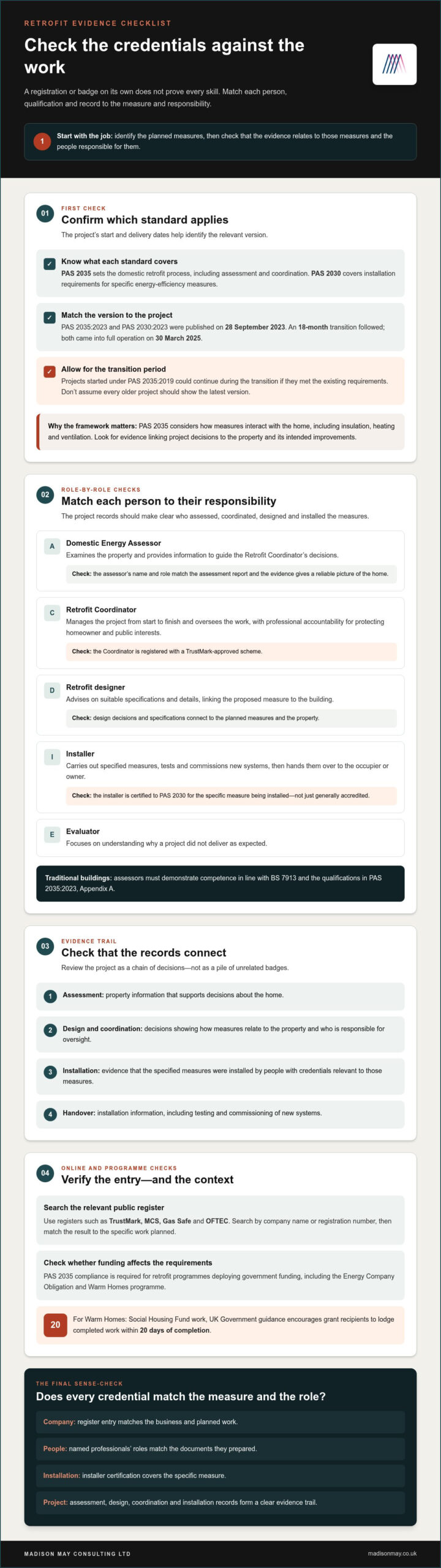
Check a retrofit company’s credentials online using public registers such as TrustMark, MCS, Gas Safe and OFTEC. Search by company name or registration number, then match the result to the specific work being carried out. For checking a retrofit company’s credentials, one registration or badge is not proof of every skill. A Retrofit Coordinator must also be registered with a TrustMark-approved scheme.
It’s sensible to ask for clear evidence before work begins, especially when different specialists have separate responsibilities in a retrofit project. Registration is a useful starting point. Understanding who assesses, coordinates, designs and installs the measures helps you check that the evidence matches the job.
This guide explains how to use online registers, what PAS 2035 says about professional roles, and which records and details to look for when reviewing installer evidence. You’ll also learn how accreditation can matter for government-funded work and why the right credentials depend on the measure being installed, so you can approach the decision with greater clarity.
Key Takeaways
- Search public registers such as TrustMark, MCS, Gas Safe and OFTEC by business name or registration number, then check that the entry relates to the work planned.
- Use PAS 2035 roles to understand who assesses the home, coordinates the project, designs measures and carries out installation.
- Look for evidence that the Retrofit Coordinator is registered with a TrustMark-approved scheme and that installers hold credentials relevant to their measure.
- For Warm Homes: Social Housing Fund work, UK Government guidance encourages grant recipients to lodge completed work within 20 days.
- Know which records to request from installers so you can understand the proposed work, the people responsible and the evidence supporting their credentials.
PAS 2035 roles and evidence responsibilities
PAS 2035 is the British Standard for retrofitting dwellings in the United Kingdom. It was published in May 2019 following the Each Home Counts Review. Rather than treating an energy upgrade as an isolated installation, its framework considers how measures interact with the home. That matters because insulation, heating and ventilation choices can affect one another. For a homeowner, the evidence should show how the project’s decisions relate to the property and its intended improvements.
The current standards have a defined publication and transition history. PAS 2035:2023 and PAS 2030:2023 were published on 28th September 2023, followed by an 18-month transition period. Both came into full operation on 30th March 2025. Projects started under PAS 2035:2019 could continue during the 18-month transition period if they met the existing requirements. So, when reviewing records, look for the standard version relevant to the project’s start and delivery, rather than assuming every older project should show the latest version.
PAS 2035 and PAS 2030 have related but distinct functions. PAS 2035 sets the domestic retrofit process, including how measures are assessed and coordinated. PAS 2030 covers installation requirements for specific energy-efficiency measures. Under PAS 2035, each measure must be installed by an installer certified to PAS 2030 for that measure. The evidence should therefore connect the proposed work to the relevant installer certification, not simply show a general company credential.
Roles also shape the project evidence. An assessor records property information for decision-making; a Retrofit Coordinator manages the project and its oversight; a retrofit designer advises on suitable specifications and detailing; installers carry out specified measures. These responsibilities should be visible in the project records, including the assessment, design decisions, coordination and installation information. For traditional buildings, competence has an additional conservation dimension: assessors must demonstrate competence in line with BS 7913 and the qualifications in PAS 2035 (2023), Appendix A.
The funding route can make compliance a formal requirement. PAS 2035 compliance is required for retrofit programmes deploying government funding, including the Energy Company Obligation and Warm Homes programme. PAS 2035/2030:2019 became a mandatory requirement for all Energy Company Obligation projects in July 2021. For social housing funding, UK Government guidance encourages grant recipients to lodge work within 20 days of completion. These dates and records help establish which process applies and when completed work should be documented. A clear evidence trail lets a homeowner or landlord understand who made each decision, which standard applied, and how the installed measures relate to the agreed retrofit plan.
Retrofit assessors, coordinators, designers and installers
Each retrofit role involves different responsibilities, so one qualification rarely tells the whole story. A Domestic Energy Assessor examines the property and provides information to guide the Retrofit Coordinator’s decisions. The assessment should give the coordinator a reliable picture of the home, not simply list possible upgrades. The coordinator manages the project from start to finish and is professionally accountable for protecting homeowner and public interests.
A retrofit designer may be an architect or another design professional. They advise on suitable specifications and details, linking the proposed measure to the building. Installers carry out the measures specified by the coordinator and designer. They test and commission new systems before handing them over to the occupier or owner. An evaluator has a different focus: understanding why a project did not deliver as expected.
Qualifications help distinguish these responsibilities. City & Guilds lists the Level 2 Award in Retrofit under accreditation number 610/1199/X. The Level 2 Certificate in Retrofit is 610/2251/2, while the Level 3 Certificate for Retrofit Advisors is 610/2988/9. The Level 3 certificate can be certified until 31/12/2031. The Level 4 Award for Domestic Retrofit Assessors can be certified until 31/12/2033. These are separate qualifications, so match the award to the role shown in project documents.
Accreditation is supported by continuing professional development and audit requirements. Retrofit Assessors must complete at least 10 hours of continuing professional development annually, including at least 5 hours of certificated attendance CPD. An assessor lodging reports at least once a year must receive at least 1 audit per year. The audit must cover at least 1% of reports lodged in each calendar year. These records help demonstrate ongoing competence, not just initial training.
For an Elmhurst assessor, use Elmhurst’s own assessor search and compare the listed details with the name or reference on the assessment report. Check that the person’s role fits the document they prepared. If a report contains a defective element, the assessor must replace it within 5 working days and confirm in writing that the Retrofit Coordinator has been informed.
- Match each named person to their role and project document.
- Compare qualification titles and accreditation numbers carefully.
- Check that assessment, design and installation evidence connect to the same planned measures.
This role-by-role approach makes checking a retrofit company’s credentials more precise: assess each person’s evidence against the work they are responsible for.
Can I check accreditation online?
Yes. Public registers let you search by business name or registration number, but the relevant scheme depends on the work. Match each result to the measure and role involved.
Checking Public Accreditation Registers
Public accreditation registers are searchable online records that show whether a business or individual holds a listed registration. MCS, TrustMark, Gas Safe and OFTEC each provide a register searchable by company or registration number. Search using the exact trading name or reference, then compare the result with the name on the quote and the work proposed.
Check the scope of a registration, not just whether a listing exists. Registration for one activity does not establish authorisation for every retrofit measure. For example, a heating installer’s entry should relate to the heating work in your project. If the result shows a different name, clarify the connection before treating it as a match.
Keep a dated record of the register entry and its details alongside the proposal. This makes it easier to compare the information if the installer, subcontractor or named business changes before work begins.
TrustMark Registration and Approved Schemes
TrustMark is a quality scheme used for retrofit work under government-backed routes, with its own Code of Conduct, Code of Practice and Customer Charter. A Retrofit Coordinator must register with a TrustMark-approved Retrofit Coordinator scheme. Checking the coordinator’s scheme entry helps distinguish their professional registration from the installer’s business registration.
Installers carrying out Energy Company Obligation measures must be registered with TrustMark. Installers on the Warm Homes: Social Housing Fund must also be TrustMark-registered. Search the TrustMark register using the business name or registration number, then compare the listed business with the organisation named in the project documents.
Subcontracting matters too. Under TrustMark’s Framework Operating Requirements, a registered business must accept full responsibility for subcontracted work or ensure the subcontractor is also TrustMark-registered. A different name on site should therefore connect clearly to the registered business or have its own relevant registration.
Checking Gas Safe and OFTEC Registration
For gas work, check the Gas Safe Register. Search the public register using the installer’s name or registration number, then compare the result with the person or business expected to do the work. OFTEC also provides a public register searchable by company or registration number, making it relevant for work within its registration scope.
These registers cover specific trades; they are not substitutes for checking retrofit credentials overall. For example, a Gas Safe entry relates to gas work, while TrustMark and PAS 2030 evidence address other parts of retrofit delivery. Match each register result to the measure, named installer and project paperwork.
Confirming Installer Authorisation for Retrofit Work
To check PAS 2035 and PAS 2030 accreditation for retrofit work, distinguish the process from the installation: PAS 2035 governs the retrofit framework, while PAS 2030 certification applies to installers and specific measures. Under PAS 2035, each energy-efficiency measure must be installed by an installer certified to PAS 2030 for that measure. Compare the measure named in the plan with the installer’s relevant evidence.
To confirm an installer is authorised under a government scheme and avoid retrofit grant scams, verify the business on the relevant public register and check that the proposed work falls within its registration. Match claims of government approval to the named scheme and registered business rather than treating the claims as proof. Compare names across the register, quote and project documents. Unexplained differences leave the authorisation trail unclear.
Does the Retrofit Coordinator and the company they are working for have to register with the TrustMark?
A Retrofit Coordinator must register with a TrustMark-approved Retrofit Coordinator scheme. A company’s registration depends on its role and route. For example, installers carrying out Energy Company Obligation measures must be TrustMark-registered.
Retrofit Coordinator Accreditation
Coordinator accreditation is scheme membership that shows the professional has met the relevant requirements for the role. This matters because the coordinator manages the retrofit project and is professionally accountable for protecting homeowner and public interests.
Check the coordinator’s name against their approved scheme entry, then compare it with the project records. The company does not automatically inherit the coordinator’s personal registration. For subcontracted work, TrustMark’s Framework Operating Requirements say a registered business must accept full responsibility or ensure the subcontractor is also TrustMark-registered.
Accreditation Bodies for Coordinators and Assessors
For coordinators, check registration with a TrustMark-approved Retrofit Coordinator scheme. For assessors, the PEPA Retrofit Assessor scheme sets membership competence requirements. These routes cover different roles, so identify who prepared the assessment and who coordinates the project.
Ask which scheme covers the person’s role and compare their name with the registration evidence. A qualification certificate alone does not establish current scheme membership. This distinction helps clarify who has the appropriate skills for project decisions and who is responsible for the evidence supporting the proposed measures.
Checking Qualification Accreditation Numbers
Qualification accreditation numbers identify specific awards, allowing you to compare a certificate with its exact qualification title. City & Guilds lists the Level 2 Award in Retrofit as 610/1199/X, the Level 2 Certificate in Retrofit as 610/2251/2, and the Level 3 Certificate for Retrofit Advisors as 610/2988/9.
Match the number and title on a certificate, rather than relying on a broad description such as “retrofit qualified”. The Level 3 Certificate for Retrofit Advisors can be certified until 31/12/2031. These details help distinguish an advisor qualification from evidence of coordinator scheme registration.
To check a retrofit company’s Companies House details, search its exact legal name and review the company record, filing history and status. Compare that name with the quote and any trading name, as the legal entity may differ. Insolvency information can be checked through the relevant official public records using the company’s legal name.
For customer reviews, complaints and disputes, compare feedback across independent review sources. Look for specific issues that recur rather than relying on isolated comments. Ask how complaints are handled and whether the business’s stated process aligns with its TrustMark Code of Conduct and Customer Charter.
Information to request from installers
Ask for records linking the installer, proposed measure and completed work. A quote may describe the price and scope, but not identify who will install each measure, what preparation is included or how the work will be documented. Clear written details help you compare proposals by what will actually be delivered, not just headline claims about energy efficiency.
Request a written scope naming each measure and its location in the property. For example, an insulation proposal should identify the relevant building area, preparatory work and any ventilation considerations. Ask which business will carry out each part, including subcontracted work, and how its registration relates to the measure. If government funding is involved, ask which scheme applies and what evidence the work needs to qualify.
Useful documents to request include:
- A detailed specification describing the materials, measures and work areas.
- The installer’s relevant registration details and the name of the business responsible for delivery.
- Any design or assessment information that explains how the proposed measure fits the property.
- A written schedule of work, including testing, commissioning and handover records where relevant.
- Details of how changes to the agreed scope will be recorded and approved.
If a retrofit assessor is involved, ask how the assessment informs the specification and how the installer will receive relevant findings. If the installation differs from the planned measure, request a written explanation and updated records. This creates a traceable link between the property information, agreed work and completed work, rather than leaving important decisions in verbal conversations.
What guarantees and warranties should a UK retrofit company provide? Ask for the applicable warranty terms in writing, including the work or products covered, duration, exclusions and claims process. Protection depends on the specific measure and contract, so check the documents for the exact terms rather than assuming one warranty covers every part of the project.
Ask for handover information suited to the equipment or measure installed. If a new system has been tested or commissioned, request the relevant records and guidance for the occupier. Dedicated climate and HVAC specialists, such as Ultra Air Heating and Cooling, often emphasise thorough system commissioning and clear documentation as best practice for ensuring cooling and heating systems perform reliably. For work involving several trades, clarify who handles defects or questions after completion, and whether the lead business accepts responsibility for subcontracted work or ensures the subcontractor is TrustMark-registered.
For a clearer starting point, a retrofit assessment and building survey can help identify property-specific considerations before measures are agreed. This is useful when you want the proposed improvements to reflect the home’s fabric, services and ventilation, rather than relying on a generic installation description.
Madison May Consulting: Energy efficient home improvements
Madison May Consulting Ltd helps homeowners and landlords consider energy efficient improvements through retrofit assessments and building surveys. Its PAS 2035-aligned assessments gather information about a property’s fabric, services and ventilation, supporting a report and EPC Improvement Plan with practical options for reducing heat loss.
This is a useful next step when you want to understand how potential measures relate to your home before deciding on a project. Depending on the property, improvements may include windows and doors, conservatory upgrades, insulation or heating upgrades, as well as ventilation assessments or damp remediation where relevant. A whole-house perspective can bring comfort, energy efficiency and your home’s character into the same conversation.
Shape the next step around your home
Checking a retrofit company’s credentials helps you make an informed decision. The next step is to connect the paperwork with your home. A considered plan starts with the property’s needs and how you want it to feel and function, so improvements support everyday comfort as well as energy efficiency. For homeowners also considering broader future-proofing and accessibility adaptations, specialists such as Perth Lift Company demonstrate how residential mobility solutions can be integrated into long-term plans for safer, more accessible living spaces.
Madison May Consulting Ltd offers energy efficient home improvements, including windows and doors and conservatory upgrades. If you’re considering how these options might suit your property, get in touch to discuss a practical direction for your home.
Contact Madison May Consulting Ltd to discuss your project and take the next step towards a home shaped around your needs.
Frequently Asked Questions
Is MCS the same as TrustMark?
No. MCS covers low-carbon heat and electricity products and installers, while TrustMark is a wider quality scheme used for retrofit work under government-backed routes. For example, a heat pump project may involve checking an installer’s MCS certification alongside any relevant TrustMark registration for the retrofit route. Each scheme covers different aspects of the work, so one registration is not a substitute for the other.
How do I check a retrofit company’s TrustMark registration in the UK?
Search the TrustMark public register using the business name or registration number, then compare the result with the legal or trading name on the quote. Check that the listed business is responsible for the work, especially if another company or subcontractor will attend. If subcontractors are involved, establish how their work is covered: the registered business must accept responsibility or ensure the subcontractor is also TrustMark-registered.
How do I verify a retrofit installer’s MCS certification and scope?
Use the MCS public register to search by the installer’s company name or registration number. Compare the listed business with the name on your proposal, then check that the certification relates to the low-carbon heat or electricity work offered. MCS registration is relevant to those products and installers; by itself, it does not demonstrate competence for every retrofit measure, such as insulation or ventilation work.
How do I verify installer qualifications and insurance for retrofit work?
Match the installer’s qualification or certificate to the specific measure they will install, and compare its title and accreditation number with the relevant awarding body’s records. For a Retrofit Assessor, check scheme membership and competence evidence. The accreditation scheme’s insurance must cover the activities of a Retrofit Assessor. For installation work, confirm that the installer’s PAS 2030 certification applies to the measure specified for your project.
What questions should I ask before hiring a retrofit company for insulation or a heat pump?
Ask which measures the written specification covers, who will install them, and how the design accounts for ventilation and the building fabric. For insulation, ask for the relevant PAS 2030 measure evidence; for a heat pump, ask whether the installer is MCS-certified. Also clarify what testing, commissioning and handover records you’ll receive, and how any change to the agreed work will be documented.