


What if the biting winds sweeping across the Pennines were no longer a threat to your evening’s peace, but merely a gentle backdrop to the stillness of your home? For many homeowners in West Yorkshire, the struggle to maintain a steady, comforting warmth in an exposed stone property is a familiar, wearying burden. You’ve likely spent years balancing the desire for a refined sanctuary against the reality of rising energy costs and the conflicting advice from various installers. It’s understandable to feel a sense of hesitation when considering a bespoke EPC improvement plan, especially when the fear of poor ventilation and subsequent mould growth looms over every insulation proposal.
We believe that technical compliance should never come at the expense of a home’s soul or its architectural integrity. In this guide, you’ll discover how a meticulously sequenced EPC improvement plan can bridge the gap between regulatory requirements, such as the government’s proposed 2028 deadline for reaching a Grade C rating, and the visceral need for a beautiful, breathable living space. We’ll explore the path from drafty corridors to a curated environment that’s as efficient as it is elegant, ensuring your investment is both logical and deeply personal.
Key Takeaways
- Understand how a bespoke roadmap honors West Yorkshire’s unique architectural heritage while mastering the specific environmental challenges of the Pennine climate.
- Discover the transformative power of a professional EPC improvement plan, moving beyond automated reports to a curated strategy informed by meticulous, property-specific data.
- Embrace the fabric-first philosophy to insulate the soul of your home, creating a beautifully warm sanctuary that addresses damp concerns through sophisticated, breathable solutions.
- Learn to navigate the PAS 2035 journey with grace, identifying seamless quick wins and long-term investments that elevate both energy efficiency and living comfort.
- Explore how independent, local consultancy merges technical precision with understated elegance to ensure your home remains a timeless and compliant reflection of your personal narrative.
The EPC Challenge: Navigating Energy Efficiency in West Yorkshire
Creating a home that resonates with the soul requires more than just beautiful furniture; it demands a foundation of comfort and efficiency. In the rugged, beautiful terrain of West Yorkshire, an EPC improvement plan serves as a bespoke roadmap for this property evolution. It transforms a building from a drafty relic of the industrial past into a high-performance sanctuary. While many see energy ratings as a bureaucratic hurdle, we view them as a curated strategy to preserve heritage while embracing modern sustainability. The gritstone terraces of Halifax and the isolated cottages of the Pennines possess a unique architectural narrative that standard, mass-market energy advice often ignores. We move beyond ticking boxes to focus on the seamless integration of luxury and performance.
Understanding the EPC Rating Scale in 2026
The landscape of domestic energy is shifting rapidly. By 2026, the government aims for as many homes as possible to reach a Grade C benchmark to meet net-zero trajectories. This transition reflects a more meticulous, data-driven approach to how we inhabit our spaces. Modern assessments now utilize sophisticated thermal imaging and precise airflow measurements to ensure every recommendation is grounded in reality. This precision allows homeowners to invest in an EPC improvement plan that offers genuine, measurable returns in both comfort and value. Investing in these updates doesn’t just satisfy a requirement; it enhances the daily experience of the home.
An Energy Performance Certificate is a meticulous calculation that measures a property’s projected annual energy costs alongside its total carbon dioxide emissions to provide a clear picture of its environmental and financial health.
Local Challenges: From Halifax Terraces to Pennine Cottages
West Yorkshire presents a specific set of environmental demands that require a thoughtful touch. The high-exposure weather of the Pennine hills pushes traditional building materials to their limits. Generic recommendations for cavity wall insulation often fail here because our solid-walled heritage properties require breathability to prevent damp and decay. It’s vital to recognize that what works for a modern suburban build won’t necessarily suit a stone-built cottage. Local expertise is essential for the following reasons:
- Material Sensitivity: Yorkshire stone is porous and requires lime-based mortars rather than modern cement to maintain its integrity.
- Exposure Levels: Properties on elevated Pennine sites face higher wind-driven rain loads, necessitating specialized weather-proofing.
- Aesthetic Preservation: High-performance glazing must be carefully chosen to complement historic timber frames or stone mullions.
A surveyor who understands these nuances will prioritize breathable insulation and sympathetic high-performance glazing over intrusive, synthetic alternatives. This ensures your home remains a warm, silent retreat regardless of the gale blowing across the moors. Guiding you through these Yorkshire-specific building surveys requires a partner who values the history of the stone as much as the efficiency of the boiler.
The Anatomy of a Professional EPC Improvement Plan
Standard Energy Performance Certificates often provide a generic list of improvements generated by automated software. These suggestions lack the nuance required for a West Yorkshire heritage property or a contemporary sanctuary. A truly professional EPC improvement plan serves as a curated architectural strategy; it’s a document that transcends simple compliance to protect the home’s soul. By integrating PAS 2035 standards, a framework established in June 2019 to ensure high-quality domestic retrofits, the plan provides a rigorous layer of accountability. It balances the immediate sensory delight of thermal comfort with the enduring preservation of capital value, ensuring your investment is as wise as it is beautiful.
Data Collection: The Foundation of Your Roadmap
A Retrofit Assessor begins by gathering granular evidence that a standard survey might overlook. They don’t just estimate; they meticulously measure building fabric and calculate specific u-values to understand how heat moves through your unique walls. Thermal imaging cameras are employed to reveal hidden heat loss narratives, pinpointing exactly where the cold air seeps in. This phase ensures every recommendation is grounded in the physical reality of the structure, transforming raw data into a bespoke roadmap. If you’re beginning this journey, you might consult with a specialist curator to ensure your personal vision remains central to the technical process.
Sequencing: The Art of the ‘Whole-House’ Approach
The order of interventions is just as vital as the technology used. A professional EPC improvement plan avoids the “locked-in” effect, a common pitfall where early, isolated upgrades prevent more effective measures later. Instead, it adopts a Fabric-First methodology, prioritizing the building’s envelope before introducing complex systems. This approach recognizes that approximately 35% of heat is typically lost through uninsulated walls in older UK properties. By sealing the envelope first, you create a stable environment for renewable integration, such as air-source heat pumps. The narrative moves gracefully from insulation to ventilation, and finally to green energy, ensuring a seamless transition that honors the home’s heritage while embracing a sustainable future.
- Building Fabric: Detailed assessment of masonry, timber, and glazing performance.
- Thermal Imaging: Visualizing energy leaks to justify targeted interventions.
- Strategic Sequencing: Avoiding redundant costs by planning works in a logical, tiered order.
- PAS 2035 Compliance: Adhering to the 2019 standards for risk management and quality.
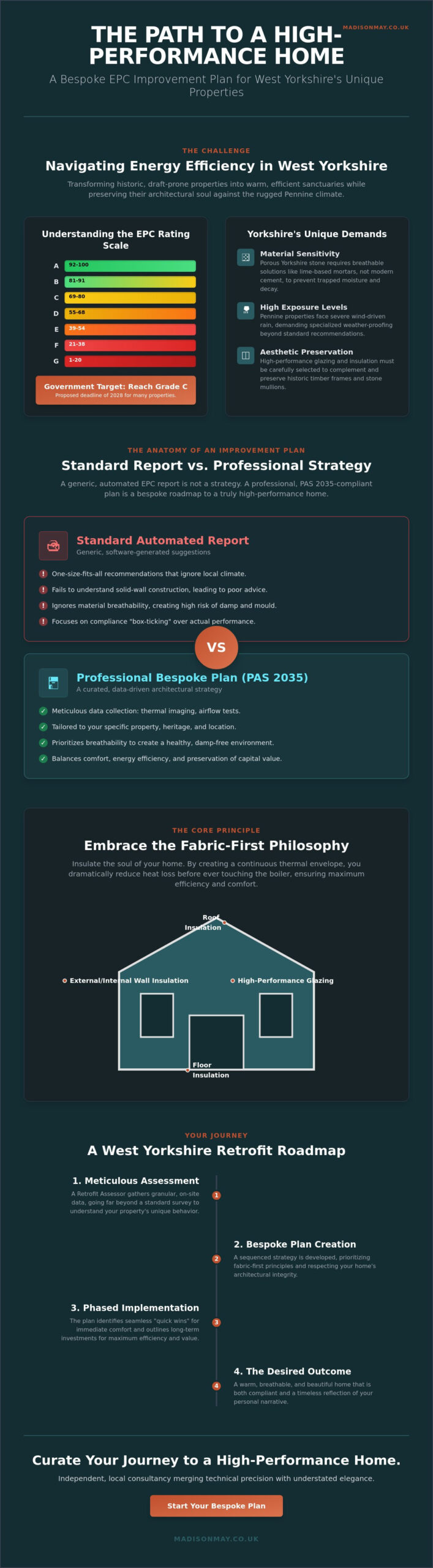
Fabric-First: Why Your Plan Must Prioritize the Building’s Soul
To craft a home that feels like a genuine sanctuary, we must look far beneath the surface. A truly effective EPC improvement plan begins with the fabric of the building itself, rather than rushing toward high-tech heating systems that the structure isn’t yet ready to support. This “fabric-first” philosophy ensures that every kilowatt of energy is cherished and retained, treating the home’s envelope as its soul. It’s about creating a thermal cocoon that works in harmony with the architecture, rather than fighting against it.
Many West Yorkshire residents hesitate to insulate, fearing that sealing a traditional stone property will invite damp and mould. This concern is valid if the approach is clumsy. When we wrap a breathable stone home in non-porous materials, moisture becomes trapped within the walls. We avoid this by selecting materials that mirror the building’s natural characteristics, ensuring the structure can still “breathe” while remaining thermally efficient. It’s a delicate balance of science and heritage.
Preserving the aesthetic integrity of our local landscape is non-negotiable. Whether it’s the rugged gritstone of a Pennine cottage or the refined sandstone of a Leeds terrace, the facade tells a story. We prioritize internal solutions that protect these historic exteriors, ensuring your EPC improvement plan enhances the home’s value without erasing its heritage. This meticulous attention to detail ensures the building remains a testament to the past while performing for the future.
Insulation Strategies for Traditional Properties
For West Yorkshire’s stone-built homes, we often recommend internal wall insulation over external cladding to keep the street-side character intact. Choosing natural materials such as wood fibre or sheep’s wool is vital; these hygroscopic materials manage moisture better than synthetic PIR boards. Meticulous attention is required for loft upgrades, where we ensure insulation extends to the very edges of the eaves without blocking essential airflow. A 2022 report by the Sustainable Traditional Buildings Alliance notes that 25% of heat loss occurs through the roof, making this a critical, high-impact starting point for any renovation.
The Ventilation Mandate: Protecting Your Sanctuary
Insulation and ventilation are two sides of the same coin. Every successful plan must include a robust strategy that complies with Part F of the Building Regulations. As we reduce drafts, we must introduce calculated airflow to prevent condensation. We use air pressure testing to measure the air change rate, ensuring the building isn’t just warm, but also healthy. This scientific approach transforms a drafty house into a controlled, serene environment where the air is as fresh as the Pennine breeze, yet the warmth remains safely within. It’s about creating a space that feels as good as it looks.
A West Yorkshire Roadmap: Implementing Your Improvement Plan
Transforming a residence into a model of efficiency requires a blend of technical mastery and aesthetic sensitivity. An effective EPC improvement plan is not merely a list of tasks; it’s a curated sequence of enhancements designed to elevate the home’s performance while respecting its heritage. This roadmap provides a structured path for West Yorkshire homeowners to follow, ensuring each intervention adds value and comfort to their living space.
- Step 1: Professional Retrofit Assessment. Commissioning a PAS 2035 assessment ensures your home is viewed as a holistic system. This professional evaluation identifies the most effective route to efficiency, preventing conflicting measures that could harm the building’s breathability or structural integrity.
- Step 2: Immediate Refinements. Focus on “quick-win” measures that offer an immediate sense of calm. Professional draught proofing and the installation of high-lumen, low-energy LED lighting provide instant improvements to the living environment with minimal disruption.
- Step 3: Fabric Upgrades. The core of the transformation involves enhancing the building’s envelope. This stage includes high-performance insulation and the integration of meticulous windows and doors that seal the home against the unpredictable Yorkshire elements.
- Step 4: Low-Carbon Heating. Transitioning to air source heat pumps represents a significant step toward a sustainable future. These systems work most effectively when the home’s fabric is already optimised, allowing for a gentle, consistent warmth.
- Step 5: Final Validation. The journey concludes with a formal inspection to validate the upgrades. This results in an updated EPC certificate that reflects the property’s renewed vitality and increased market value.
Navigating MEES and Landlord Compliance
For those managing property portfolios, the evolution of Minimum Energy Efficiency Standards (MEES) presents a clear deadline for action. Current policy trajectories suggest a requirement for a Grade C rating by 2028 for all tenancies. Landlords who fail to adapt risk substantial financial penalties and the prospect of their properties becoming legally unlettable. A strategic EPC improvement plan serves as a shield against these risks, replacing reactive, expensive repairs with a cohesive vision. You can explore the specific requirements through this MEES Regulations in West Yorkshire checklist to ensure your investments remain both compliant and inviting for discerning tenants.
Investing in Craftsmanship: Windows, Doors, and Conservatories
The dialogue between beauty and performance is most evident in a home’s glazing. Selecting high-performance glass with superior U-values doesn’t mean compromising on the elegance of bespoke joinery or the character of a period property. Meticulous conservatory upgrades in Halifax demonstrate how underutilised, drafty spaces can be reborn as thermal sanctuaries. By balancing modern thermal technology with timeless design, you ensure that every window and door serves the property’s narrative of comfort, style, and enduring quality.
Ready to refine your home’s performance with elegance? Consult with Madison May to begin your bespoke journey toward a more efficient sanctuary.
Madison May: Curating Your Journey to a High-Performance Home
At Madison May, we believe a home should be a reflection of its owner’s story, a sanctuary that provides both aesthetic delight and enduring comfort. Our philosophy bridges the gap between technical rigour and understated elegance. While others see a property as a collection of walls and windows, we view it as a living environment that requires a meticulous touch. As an independent, West Yorkshire-based consultancy, we understand the unique architectural heritage of our region. From the grand Victorian terraces of Halifax to the converted barns of the Pennines, we provide local residents with a level of expertise that respects the past while securing a sustainable future.
We act as your Project Guardian through the Retrofit Coordination process. This role is about more than just oversight; it’s about protecting the integrity of your vision and the health of your home. We manage the complexities of building science so you don’t have to, ensuring that every modification is executed with grace and precision. This transformative artistic journey turns a standard dwelling into a high-performance masterpiece.
Bespoke Consultancy for Discerning Clients
Generic reports often fail to capture the essence of a home. They offer standardized solutions that ignore the nuances of your daily life. Our approach moves beyond these basic documents to provide a personalized lifestyle consultation. When crafting a bespoke EPC improvement plan, we consider the interplay of light, heat, and air to ensure a seamless integration of technology and heritage.
We embrace the Whole-House principle, ensuring that every intervention works in harmony with the building’s fabric. This commitment to lasting comfort is detailed in our guide on improving your EPC rating, which explores how technical efficiency and beautiful design coexist. By focusing on the soul of the property, we create spaces that are as efficient as they are evocative.
Take the First Step Toward Your Sanctuary
Your property’s transformation begins with a quiet conversation. When you book an initial assessment in Halifax or the wider Yorkshire region, you aren’t just hiring a consultant. You’re inviting a partner to curate the next chapter of your home’s narrative. During our first consultation, we focus on listening to your requirements and observing the subtle details of your space. We’ll outline a clear, professional path forward that balances functional performance with visual grace. It’s time to elevate your living experience and find peace in a home that performs beautifully. You can begin your EPC improvement plan today and rediscover the quiet confidence of a high-performance sanctuary.
Curating the Future of Your West Yorkshire Heritage Home
The path to a high-performance home requires a delicate balance between modern thermal efficiency and the preservation of architectural character. By prioritizing a fabric-first approach, you protect the building’s soul while meeting the rigorous PAS 2035 standards that define excellence in domestic retrofit. According to the Department for Energy Security and Net Zero, improving a property’s efficiency from an EPC band E to C can significantly reduce annual energy costs, often by over £400 based on recent price caps. Your EPC improvement plan acts as a sophisticated roadmap, ensuring that every intervention is intentional and every material is chosen with care.
Madison May brings specialist West Yorkshire heritage expertise and meticulous retrofit coordination to every project, transforming a technical necessity into a journey of refined craftsmanship. We invite you to book your bespoke EPC improvement plan consultation to begin this transformative process. Together, we’ll create a sanctuary that reflects your personal narrative while standing as a testament to sustainable luxury. Your home’s next chapter is waiting to be written with poise and precision.
Frequently Asked Questions
What is included in a professional EPC improvement plan?
A professional EPC improvement plan includes a detailed site survey, energy modeling, and a sequenced list of fabric-first upgrades tailored to your home’s unique architecture. It provides a bespoke roadmap that evaluates wall insulation, glazing performance, and heating efficiency. By following this curated strategy, homeowners can transform a drafty residence into a refined sanctuary while ensuring every technical detail aligns with long term sustainability goals.
How much does it cost to move a property from EPC D to C?
Moving a property from EPC D to C typically costs between £6,000 and £15,000 depending on the building’s age and construction type. According to the Climate Change Committee’s 2023 report, the average investment for a semi-detached home is approximately £10,000. These figures cover essential improvements like loft insulation, cavity wall treatments, and modernizing heating controls to create a more efficient, serene environment.
Can I get an EPC improvement plan for a listed building in West Yorkshire?
Yes, you can obtain a specialized EPC improvement plan for listed buildings that respects the heritage and soul of West Yorkshire’s historic architecture. These plans focus on breathable materials and sensitive upgrades that satisfy both energy requirements and local planning authorities. Expert consultants ensure that your timeless home meets modern standards without compromising the intricate details that define its unique character and aesthetic value.
Why should I choose a Retrofit Assessor over a standard EPC assessor?
A Retrofit Assessor provides a more comprehensive, holistic evaluation than a standard EPC assessor by considering the entire building’s health and ventilation. While a standard assessment offers a basic snapshot, a Retrofit Assessor follows the PAS 2035 framework to ensure every improvement is meticulously integrated. This professional guidance prevents issues like damp or poor air quality, protecting the structural integrity and emotional comfort of your sanctuary.
How long does it take to implement a full improvement roadmap?
Implementing a full improvement roadmap generally takes between 3 and 12 months, depending on the complexity of the bespoke measures required. A simple upgrade involving loft insulation and a boiler replacement might finish in 4 weeks, while a deep retrofit including external wall insulation and heat pump installation requires more time. This measured pace ensures that every craftsman delivers quality results that resonate with your personal vision.
Will an EPC improvement plan help me access government grants?
A formal EPC improvement plan is often a mandatory requirement for accessing UK government funding like the Great British Insulation Scheme or the Boiler Upgrade Scheme. These initiatives can provide grants worth up to £7,500 for heat pumps or cover the full cost of specific insulation measures. Having a professional roadmap demonstrates a commitment to meticulous planning, making the application process smoother and more successful for discerning homeowners.
What happens if my property cannot reach an EPC Grade C?
If your property cannot reach an EPC Grade C despite a meticulous investment of £10,000, you may apply for an “All Relevant Improvements Made” exemption. This legal provision, registered on the PRS Exemptions Register, lasts for 5 years and acknowledges the physical or financial constraints of certain historic buildings. Even if the grade remains lower, the improvements still enhance the daily experience and comfort of your private sanctuary.
Does adding insulation always require a ventilation assessment?
Yes, adding insulation always requires a professional ventilation assessment to maintain a healthy indoor climate and prevent condensation. Under the PAS 2035 regulations, any change to the building’s thermal envelope must be balanced with adequate airflow to protect the home’s fabric. This thoughtful approach ensures that your living space remains a fresh, breathable environment where beauty and functionality coexist in perfect harmony.
Elegant Loft Conversion Halifax: Crafting a Sustainable Sanctuary – Madison May
August 20, 2026[…] and the launch of RdSAP 10 in June 2025, the way we measure efficiency is evolving. By following The Meticulous EPC Improvement Plan: A Roadmap, you can sequence upgrades effectively. This involves integrating high-performance insulation and […]
DIY Draught Proofing vs Professional: Choosing the Best Path for Your Home’s Efficiency – Madison May
August 20, 2026[…] serenity that a temporary DIY fix cannot match. It serves as the essential foundation for a meticulous EPC improvement plan, transforming your property from a drafty structure into a high-performance refuge where every […]
Protect Your Family’s Health: Indoor Air Quality Guide – Madison May
August 21, 2026[…] toward a visionary plan for your home. For those seeking a definitive guide for their journey, the EPC Improvement Plan serves as a meticulous roadmap, detailing every necessary step to achieve both energy efficiency […]
U-Value Building Regulations UK: A Guide to Thermal Excellence in 2026 – Madison May
August 21, 2026[…] sanctuary. To navigate this journey with precision, Madison May Consulting Ltd advocates for a meticulous EPC improvement plan, ensuring each upgrade is sequenced to honour the home’s integrity whilst meeting modern […]
The Impact of Retrofit on House Prices in West Yorkshire – Madison May
August 22, 2026[…] Green Mortgages for energy-efficient homes, directly improving your return on investment. Following The Meticulous EPC Improvement Plan ensures your path to compliance is both aesthetic and […]
The Whole House Retrofit Approach: A Meticulous Journey to Home Performance – Madison May
August 22, 2026[…] approach, it evolves into something far more powerful: a strategic roadmap for transformation. Our Meticulous EPC Improvement Plan transcends simple data, offering a bespoke narrative for your property’s future. It serves as […]
Energy Efficient Windows: A Bespoke Guide to Thermal Elegance and Home Sanctuary – Madison May
August 23, 2026[…] is the foundation of any successful renovation. A meticulous EPC improvement plan provides a clear, logical vision for your property, ensuring that every upgrade is sequenced to […]
Ventilation Assessment Halifax: Protecting Your Home’s Health and Fabric – Madison May
August 24, 2026[…] your property’s specific architectural context. This data-driven approach allows a professional EPC improvement plan to integrate seamlessly with your ventilation strategy. By treating the home as a single, […]
Retrofit Meaning: A Guide to Evolving Your Home into a Sustainable Sanctuary – Madison May
August 25, 2026[…] journey toward a sustainable sanctuary requires a clear sense of direction. An EPC improvement plan serves as this essential guide, providing a phased roadmap that organises your retrofit into […]
How to Improve Your EPC Rating: A Professional Energy Efficiency Survey Guide – Madison May
August 27, 2026[…] from raw survey data to a physical result requires a logical, cost-effective roadmap. Our EPC improvement plan pillar explains how we transform technical findings into a visionary strategy. When considering how to […]
PAS 2035: The Homeowner’s Guide to Loft Conversion Insulation Regulations in the UK – Madison May
August 29, 2026[…] meticulous EPC improvement plan serves as the essential roadmap for this holistic strategy. It ensures that any subsequent heating […]
Loft Ventilation Regulations UK: 2026 Definitive Guide – Madison May
August 30, 2026[…] that would otherwise be lost through traditional venting. This technology is a cornerstone of a meticulous EPC improvement plan, significantly boosting your home’s energy rating. Modern MVHR units are now designed […]
How to Pay for Retrofit: Financing Your Sustainable Home – Madison May
September 1, 2026[…] investigating the various home energy efficiency grants Yorkshire and other regions offer, you’ll encounter a choice between shallow, isolated measures and a […]
Heat Pump Suitability Assessment in Yorkshire: An Expert Checklist for Your Home – Madison May
September 19, 2026[…] nuances of ventilation to create a complete thermal portrait. This rigorous evaluation informs a meticulous EPC improvement plan, which acts as a strategic roadmap for your home’s enhancement. Their professional authority […]
Navigating Home Energy Efficiency Grants in West Yorkshire: A Meticulous Guide – Madison May
September 20, 2026[…] Performance Certificate (EPC) grade. This rigorous, multi-faceted approach aligns perfectly with a meticulous EPC improvement plan, transforming a draughty dwelling into a high-performing sanctuary that honours its architectural […]
The Essence of Unbiased Retrofit Consultancy: Elevating Home Performance – Madison May
September 21, 2026[…] sanctuary requires a vision that is both technically precise and aesthetically sensitive. An EPC improvement plan serves as this vision, acting as a strategic document that elevates property value whilst refining […]
Cost of Improving EPC Rating UK: A Definitive 2026 Guide to Property Enhancement – Madison May
September 21, 2026[…] post-improvement ratings with surgical precision, removing the guesswork from your investment. Our EPC improvement plan provides this exact level of foresight, ensuring your journey toward an A-rated sanctuary is both […]
Damp in Solid Walls in Leeds: Moisture Management Guide – Madison May
September 21, 2026[…] or clay-based paints, creating a surface that is as aesthetically pleasing as it is functional. An EPC improvement plan serves as a vital guide in this phase, ensuring that repairs are sequenced logically to avoid […]
2026 UK Home Energy Upgrades: A Budgeting Guide – Madison May
September 21, 2026[…] significant weight, with potential fines reaching up to £30,000 per property. This is why a meticulous EPC improvement plan should be the first entry in your budget for home energy upgrades 2026. Beyond regulation, lenders […]
Visionary Homebuyer’s Guide: Pre-purchase Retrofit Surveys – Madison May
September 25, 2026[…] EPCs frequently suffer from inaccuracies, failing to respect the unique building fabric. A bespoke EPC improvement plan serves as a strategic design tool rather than a simplified rating. Following generic EPC […]
The Benefits of a PAS 2035 Retrofit Assessment: A Roadmap to Your Home Sanctuary – Madison May
October 5, 2026[…] to deliver the desired sanctuary. The data gathered during the assessment culminates in a tailored EPC improvement plan, offering a visionary roadmap that avoids the anxiety of uncoordinated mistakes. This bespoke […]
Loft Insulation Top-Up: When to Add More and Considerations – Madison May
October 16, 2026[…] organise measures around the property rather than treating each one as a separate decision. The EPC improvement plan guide explains how recommendations can be arranged into a […]