


An Energy Performance Certificate is far more than a mandatory compliance document; it is a meticulously crafted narrative of your home’s heritage and a visionary blueprint for its sustainable future. If you have been searching for clarity in understanding my EPC report Halifax, you likely recognise that technical SAP ratings often feel cold and disconnected from the lived experience of your sanctuary. It’s natural to feel a sense of hesitation when faced with generic recommendations, especially whilst fearing that incorrect insulation advice might compromise the delicate breathability of your building’s fabric.
We believe every improvement should be an intentional step towards a harmony of functionality and beauty. This guide promises to decode the shifting landscape of energy metrics, including the new headline measures for fabric performance and smart readiness arriving in October 2026. You will gain a clear understanding of your property’s current standing, which is increasingly vital now that lenders like Halifax incorporate these ratings into mortgage affordability. We’ll explore a professional roadmap for upgrades that enhance your home’s unique character, ensuring your journey towards a more energy-efficient refuge is both informed and inspired.
Key Takeaways
- Interpret your certificate’s technical data not as a dry score, but as a detailed narrative of your home’s unique thermal character and carbon footprint.
- Navigate the specific challenges of West Yorkshire’s architectural heritage, ensuring that understanding my EPC report Halifax empowers you to meet the evolving requirements of local mortgage lenders.
- Uncover why following one-size-fits-all insulation advice in isolation can be counterproductive, potentially leading to damp issues if the building’s natural ventilation isn’t carefully considered.
- Learn how to elevate a standard assessment into a sophisticated Retrofit Roadmap, using deep data to create a sanctuary that is as sustainable as it is beautiful.
- Discover the value of a visionary, design-led approach that prioritises your personal story whilst meticulously enhancing your property’s enduring quality.
Decoding the Energy Performance Certificate: A Narrative of Your Home’s Efficiency
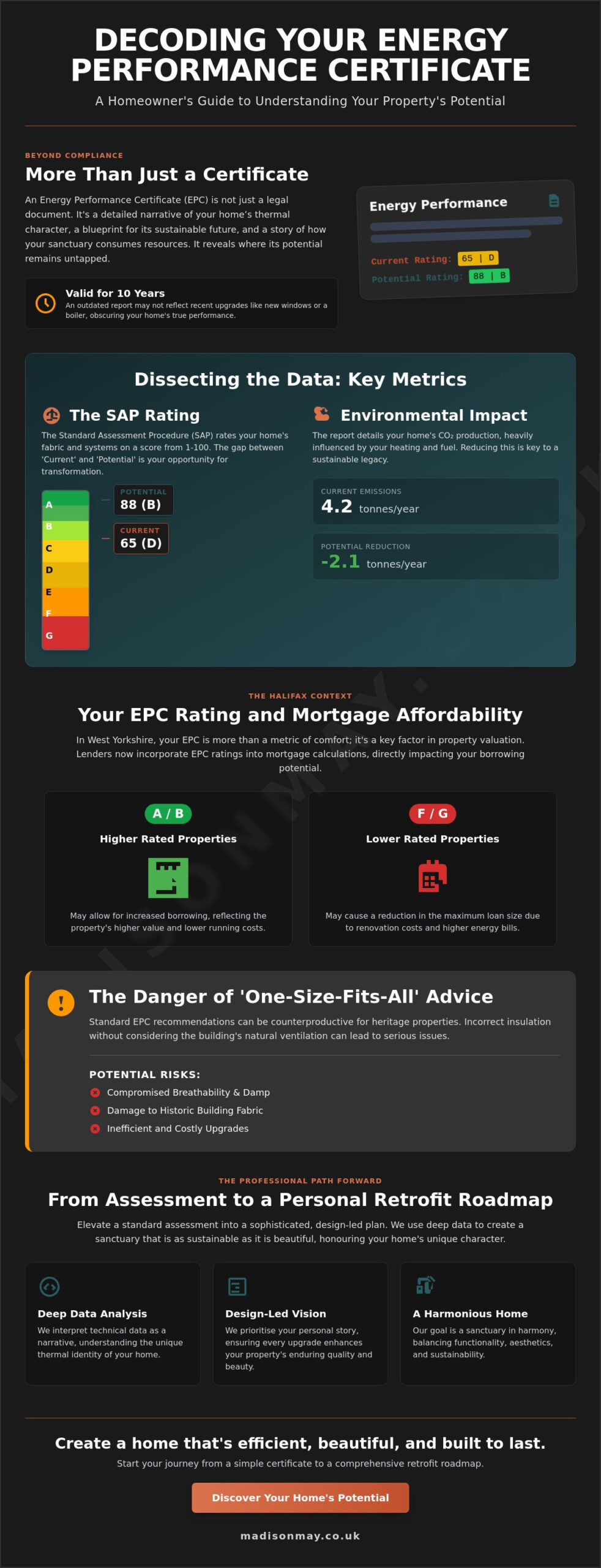
An Energy Performance Certificate (EPC) serves as a meticulous record of a property’s thermal identity, offering a standardised reflection of how your home breathes and retains warmth. Whilst many view it simply as a legal necessity for a property transaction, its true worth lies in the data it reveals about your building’s unique character. When you are focused on understanding my EPC report Halifax, it is helpful to view the document as a story of how your sanctuary consumes resources and where its potential remains untapped. Most housing stock across the UK currently sits amongst the middle bands of the A to G spectrum. This isn’t a failure of design; rather, it’s a reflection of the architectural standards of the eras in which our homes were built.
It’s vital to remember that a certificate remains valid for ten years. However, a report from several years ago may no longer reflect the current reality of your living space. If you’ve replaced windows, upgraded a boiler, or added insulation, the existing document becomes a historical record rather than a live assessment. Relying on an outdated report can obscure the true performance of your home, making it difficult to plan the next steps in your property’s evolution. By looking deeper into the metrics, you move beyond mere compliance and begin to see a professional roadmap for refinement.
The SAP Rating Explained
The Standard Assessment Procedure, or SAP, acts as the mathematical engine that powers your certificate. It’s a precise calculation that produces a score out of 100, which then dictates which band your home falls into. This rating doesn’t merely look at your energy bills; it evaluates the inherent quality of the building fabric and the efficiency of installed services. Your report will highlight two distinct figures: the current efficiency and the potential rating. This gap represents a transformative opportunity. It shows exactly what is achievable if you choose to invest in the enduring quality of your home’s infrastructure.
Environmental Impact and Carbon Emissions
Beyond the financial metrics, your report provides a window into your home’s environmental story by detailing the estimated tonnes of CO2 produced each year. This figure is deeply influenced by your heating systems and the primary fuel types you use. In the context of Halifax properties, which often feature beautiful heritage stone and traditional craftsmanship, reducing carbon is a delicate art. It’s about honouring the building’s history whilst integrating modern technology to ensure its longevity. Every reduction in carbon emissions is a step towards preserving both the environment and the fabric of the building itself, creating a legacy of sustainability for the future.
Understanding My EPC Report Halifax: The Metrics of Comfort and Carbon
Halifax is unique. It’s a town defined by rugged stone terraces and historic charm, but it’s also a name synonymous with one of the UK’s largest mortgage lenders. When you’re focused on understanding my EPC report Halifax, you’re likely navigating both the physical reality of a West Yorkshire home and the financial expectations of modern banking. The architectural heritage of our region, from solid stone builds to mid-century developments, presents specific challenges that a generic report might fail to articulate. This document is no longer just a piece of paper for the files; it has become a vital tool for property valuation.
Lenders like Halifax now incorporate EPC ratings into their mortgage affordability calculations. According to current data, applicants for properties with an A or B rating may be able to borrow more, whilst those for F or G rated properties might see a reduction in their maximum loan size. This shift turns the clinical data of the report into a significant factor in your financial journey. The sensory experience of a draughty home, where the chill lingers in the corners of a stone-walled room, is finally being quantified. Your primary heating source and its interplay with the building fabric determine whether your home is viewed as a liability or a sustainable sanctuary.
The Estimated Energy Costs Section
Within the report, you’ll find a section dedicated to estimated energy costs over a three-year period. It’s essential to recognise that these figures aren’t based on your personal lifestyle or how often you turn up the thermostat. Instead, they rely on standardised assumptions about occupancy and heating patterns to provide a level playing field for comparison. These estimates serve as a baseline for prioritising your investment. They help you identify where a bespoke EPC Improvement Plan could yield the most meaningful returns, transforming your property’s efficiency through targeted upgrades.
Features and Star Ratings
The features section uses a five-star scale, ranging from “Poor” to “Very Good,” to describe elements like your walls, roof, and windows. For many Halifax homeowners, solid stone structures often receive a lower rating simply because they lack the modern cavities required for standard insulation. This is where preparation becomes paramount. Providing an assessor with evidence of previous work, such as high-performance glazing or internal wall insulation, prevents the software from defaulting to “assumed” low ratings. You can consult the official government guidance on EPCs to ensure you have the correct documentation ready, ensuring your home’s true potential is accurately reflected on the final certificate.
Beyond the Surface: Why Standard Recommendations Require a Meticulous Eye
Standard energy reports often present a list of recommendations as if they were simple, isolated tasks to be completed in any order. However, treating energy efficiency as a series of disconnected boxes to tick poses a significant risk to your home’s long-term health. When you’re focused on understanding my EPC report Halifax, it’s essential to look beyond the automated list generated by a software algorithm. A house is a living system where every change to the fabric affects how air moves and moisture behaves. Following one recommendation in isolation can be counterproductive, potentially creating new problems whilst trying to solve old ones.
A whole-house philosophy ensures that every upgrade is an intentional step towards a harmony of functionality and beauty. We understand that your home is a personal refuge, not just a set of data points. By taking a meticulous approach, you ensure that improvements enhance the building’s character rather than compromising it. This perspective is vital when deciphering the clinical data found in official government guidance on EPCs, as it allows you to filter generic advice through the lens of your property’s unique architectural story.
The Ventilation Gap
Sealing a home too tightly to prevent heat loss often creates an unintended consequence known as the “Ventilation Gap.” If you install high-performance windows or thick insulation without integrated damp remediation strategies, you risk trapping stale, humid air inside. This imbalance leads to condensation and mould, turning a refined sanctuary into a damp-prone environment. Building Regulations Part F exists to ensure that as we make our homes warmer, we also keep them breathable. Professional building surveys are indispensable here, identifying hidden risks in the building fabric that a standard assessor might miss during a brief visit. Understanding my EPC report Halifax means recognising that warmth must never come at the expense of air quality.
Generic vs. Bespoke Recommendations
The “top actions” list on your certificate is a standardised output, not a curated design plan. It doesn’t account for the heritage of a stone terrace or your future plans for a loft conversion. Following these suggestions in the wrong sequence can lead to wasted investment and aesthetic compromises. A professional EPC improvement plan offers a more sophisticated alternative, sequencing upgrades to work in harmony with your property’s specific needs. For example, whilst external wall insulation might offer high energy gains on paper, it could permanently obscure the beautiful masonry of a heritage property. Balancing these thermal gains with the visual identity of your home requires a visionary, design-led approach that prioritises your personal story.
From Assessment to Action: Crafting Your Personal Retrofit Roadmap
While the document provides a useful baseline, understanding my EPC report Halifax is merely the first chapter in a much deeper narrative of property refinement. Many homeowners find themselves at a crossroads once the assessor leaves; they possess the data, but lack the professional roadmap to execute it with precision. A basic EPC is a compliance tool, but a sophisticated retrofit strategy is a visionary commitment to your home’s enduring quality. This transition requires a shift from superficial observations to the gathering of deep data, where a Retrofit Assessor meticulously evaluates the interplay between your building’s fabric, its services, and its ventilation needs.
Every material chosen and every measure installed should be part of a seamless experience that prioritises your personal story. Coordination is essential here. Without a steady, graceful hand overseeing the project, even the best intentions can lead to fragmented results. By identifying the low-hanging fruit, such as professional draught proofing, and balancing it with transformative structural changes like loft conversions or heating upgrades, you create a sanctuary that resonates on a personal level. This measured approach ensures that your home’s transformation is as much about the emotional impact of the space as it is about the clinical metrics of energy performance.
The PAS 2035 Gold Standard
Adopting the PAS 2035 framework represents the meticulous gold standard for domestic projects. This benchmark ensures that every material is chosen with care and every installation is overseen by a qualified Retrofit Coordinator. It acts as a safeguard against technical failure, protecting your sanctuary from the unintended consequences of poor-quality workmanship. This level of coordination provides a sense of calm and luxury, reassuring you that your home is in capable, patient hands throughout its transformation. It is the definitive way to ensure that understanding my EPC report Halifax leads to meaningful, lasting improvement rather than temporary fixes.
Prioritising Your Upgrades
A successful journey always begins with a “Fabric First” philosophy. Before considering complex heating upgrades or renewable technology, you must focus on the integrity of the building envelope. Insulation and draught-proofing should almost always precede the installation of heat pumps or solar arrays. Sealing the envelope first ensures that your home retains warmth effortlessly, allowing modern systems to operate at their peak without being overtaxed. This logical sequence prevents the waste of resources and ensures your property remains a calm, comfortable retreat, even during the most significant phases of refurbishment. If you are ready to move beyond the data and begin your personal journey of transformation, enquire about a professional Retrofit Assessment to define your home’s true potential.
Madison May: Curating Your Home’s Transformation into a Sustainable Sanctuary
We view the process of refining a property not as a series of technical hurdles, but as a transformative artistic journey. Whilst understanding my EPC report Halifax provides the initial spark of awareness, Madison May Consulting Ltd serves as your sophisticated guide through the complexities that follow. We bridge the gap between clinical data and the finished, high-performance environment you desire. Our commitment to a visionary, design-led approach ensures that every detail is intentional, prioritising your personal story as we craft a sanctuary that reflects your identity and values. We act as attentive listeners and thoughtful experts, ensuring that the intersection of functionality and beauty feels natural and effortless.
The transition from a standard certificate to a fully realised, energy-efficient home requires more than just installation; it demands curation. We bring a sense of grace and poise to every project, letting the clarity of our vision speak for itself. By positioning Madison May Consulting Ltd as a trusted curator of your lifestyle, we ensure that every material chosen resonates with the heritage of your building. This meticulous attention to detail transforms a simple home improvement project into a meaningful evolution of your living space, where the final result is a harmonious blend of modern performance and timeless aesthetics.
Our Bespoke Consultancy Services
Our fixed-fee Retrofit Assessments delve far deeper than the surface-level observations of a standard certificate. We gather deep data on the building fabric, services, and ventilation to create a comprehensive understanding of your property’s current behaviour. From this foundation, Madison May Consulting Ltd develops detailed improvement plans that act as a meticulous roadmap for your home’s future. These plans are not generic suggestions; they are personalised strategies that honour the architectural integrity of your property. Our Retrofit Coordination services then ensure that every upgrade, from insulation to heating, is executed with the same level of craftsmanship and care that defines our design philosophy.
Begin Your Journey Today
There has never been a more poignant moment to evaluate your energy efficient home improvements. As the landscape of property standards evolves, the emotional and financial rewards of a meticulously upgraded home become increasingly clear. A home that is energy efficient is not just a sustainable choice; it’s a calmer, more comfortable refuge that offers a sense of enduring quality. We invite you to begin your transformative journey with us. Contact Madison May Consulting Ltd to arrange a thoughtful, expert review of your current EPC and property potential. Together, we can unlock the true potential of your home, turning understanding my EPC report Halifax into a visionary plan for a refined, sustainable sanctuary.
Curating Your Property’s Sustainable Legacy
Refining a property is an act of stewardship that balances contemporary efficiency with the timeless soul of the building. By moving beyond the automated suggestions found on a standard certificate, you ensure that every upgrade, from draught proofing to heating, serves to enhance rather than compromise your sanctuary. understanding my EPC report Halifax is the initial step in this narrative, providing the essential data required to craft a professional roadmap that prioritises both comfort and carbon reduction.
Our West Yorkshire specialists bring a national perspective to every project, ensuring that your home’s transformation is guided by PAS 2035 aligned expertise. This commitment to meticulous quality ensures that your journey remains seamless, protecting the integrity of your building fabric whilst elevating your living experience. We invite you to begin your journey towards a more efficient sanctuary with Madison May Consulting Ltd. Let us help you curate a space that is as sustainable as it is beautiful, turning clinical metrics into a visionary legacy of comfort and calm.
Frequently Asked Questions
Is my EPC report still valid if I have made improvements to my home?
Your certificate remains legally valid for its ten-year duration regardless of any refinements you’ve made to the property. However, it will no longer reflect the true thermal character of your sanctuary if you’ve invested in energy efficient home improvements. Commissioning a new assessment after installing high-performance windows or insulation ensures that your home’s narrative is accurate and its value is fully recognised.
Can a low EPC rating affect my mortgage application with lenders like Halifax?
Financial institutions now increasingly integrate energy metrics into their lending decisions and affordability calculations. When you’re focused on understanding my EPC report Halifax, it’s vital to recognise that a rating of ‘F’ or ‘G’ can lead to a reduction in maximum loan sizes. Conversely, properties with an ‘A’ or ‘B’ rating often benefit from more favourable terms, as lenders view these as lower-risk, sustainable investments.
What is the difference between a standard EPC and a PAS 2035 Retrofit Assessment?
A standard EPC is a high-level compliance document designed primarily for property marketing and sales. In contrast, a PAS 2035 Retrofit Assessment is a meticulous deep dive into the building’s fabric, ventilation, and occupancy patterns. This sophisticated framework provides a professional roadmap for upgrades, ensuring that every material chosen works in harmony with your home’s unique heritage and prevents technical failure.
Why does my EPC recommend measures that seem unsuitable for my older property?
Certificates are generated by automated software that prioritises standardised cost-effectiveness over architectural nuance. For heritage stone terraces, these generic suggestions often ignore the essential need for breathability in traditional building fabrics. This is why a bespoke EPC Improvement Plan is essential; it filters technical data through a visionary lens to protect the building’s character whilst enhancing its thermal performance.
How much can I realistically improve my EPC rating through insulation alone?
Meticulous insulation upgrades can often elevate a property by one or two full bands on the A to G scale. The actual impact depends on your home’s starting point and the specific materials used during the refurbishment. Combining loft and wall insulation with professional draught proofing creates a sealed, high-performance envelope that significantly reduces energy demand and carbon emissions without compromising the building’s integrity.
Do I need a new EPC if I am a landlord and the regulations have changed?
Landlords must ensure their properties meet evolving Minimum Energy Efficiency Standards (MEES) to remain compliant. With the threshold set to rise from ‘E’ to ‘D’ by 2026, you’ll need a new assessment if your current rating falls short of this requirement. Proactive refurbishment ensures your rental portfolio remains a refined and legal sanctuary for tenants, avoiding the risk of substantial non-compliance fines.
What happens if my property is exempt from reaching the minimum EPC standards?
If your property cannot reach the required rating despite meeting the £10,000 cost cap for improvements, you must apply for an entry on the PRS Exemptions Register. These exemptions typically last for five years and cover scenarios where measures would negatively impact the property’s value or are technically unfeasible. It’s a necessary step to maintain compliance whilst you continue to curate your home’s long-term sustainable transformation.