


What if that disappointing letter on your Energy Performance Certificate isn’t a final verdict on your home’s worth, but rather the first draft of its most rewarding transformation? Receiving a lower grade than expected often feels like a personal setback, leaving many homeowners and landlords questioning what to do after a bad EPC rating UK whilst staring at a document filled with dense technical jargon. It’s natural to feel a sense of unease, particularly with the potential for fines up to £5,000 for non-compliant rental properties or the anxiety surrounding the true cost of necessary thermal upgrades.
We understand that your home is more than a set of data points; it’s a sanctuary where comfort and heritage should meet modern efficiency. This guide promises to help you transform a disappointing rating into a strategic roadmap for a warmer, more valuable, and energy-efficient environment. We shall explore whether to challenge your current certificate, how to navigate the £3,500 cost cap for landlords, and the precise sequence of improvements, from fabric-first insulation to sophisticated heating upgrades, needed to secure a C rating or better. By the end, you will have the clarity to move from confusion to a curated plan for your property’s future.
Key Takeaways
- Understand how an EPC rating below a C influences your property’s long-term market valuation and its eligibility for favourable green mortgage products.
- Learn the precise steps to challenge an inaccurate assessment by replacing default assumptions with professional evidence of your home’s existing insulation.
- Discover exactly what to do after a bad EPC rating UK by crafting a bespoke improvement plan that transforms your residence into a high-performance sanctuary.
- Master the “Fabric First” methodology, ensuring that your home’s envelope is perfectly insulated before you transition to advanced, low-carbon heating technologies.
- Recognise the essential balance between airtight insulation and thoughtful ventilation to maintain a healthy environment whilst protecting your home from damp and mould.
Understanding the Implications of a Substandard EPC Rating
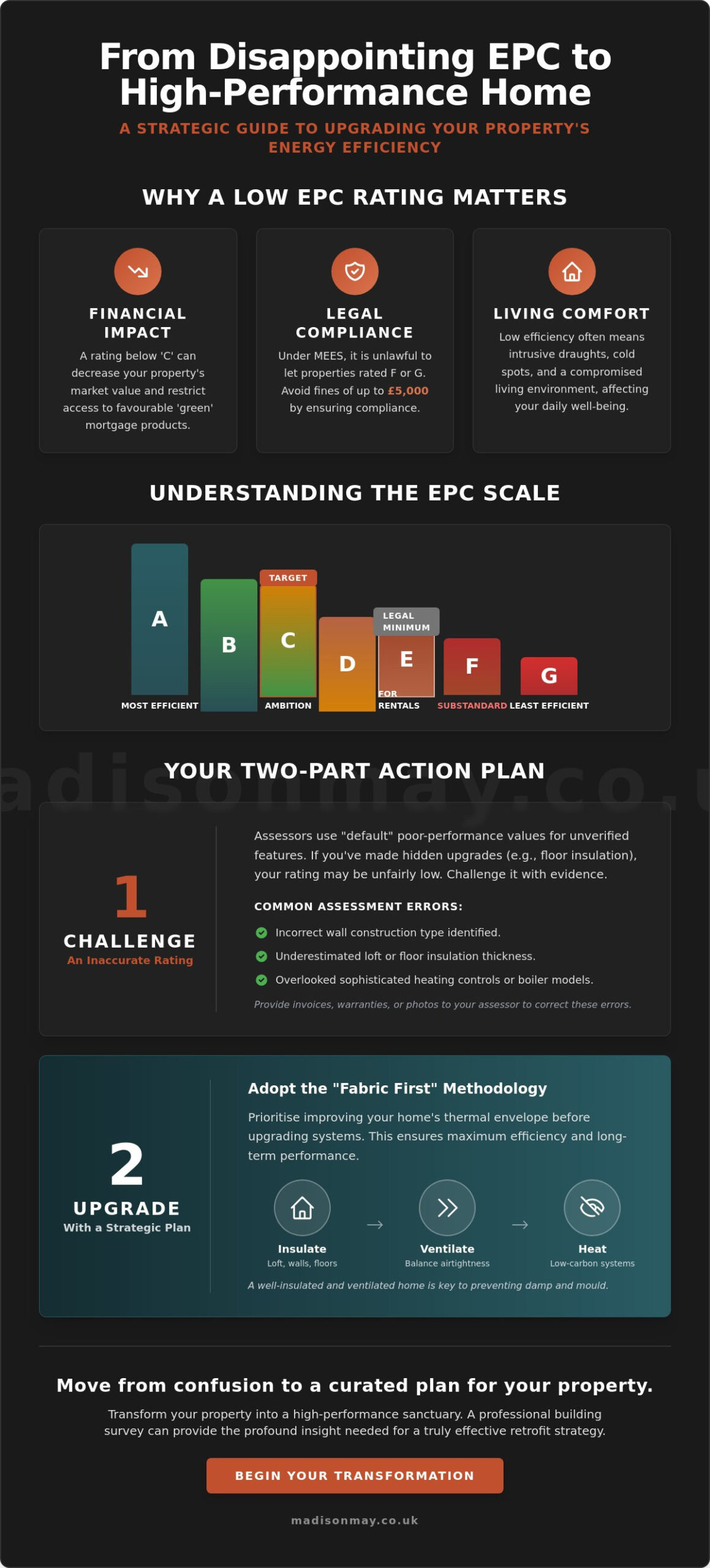
An Energy Performance Certificate (United Kingdom) is far more than a bureaucratic necessity; it’s a vital health check for your home’s efficiency and longevity. Whilst the official scale spans from A to G, the definition of a substandard rating has evolved alongside our understanding of domestic comfort. In the current market, any score below a C is increasingly viewed as a limitation. This isn’t merely a matter of environmental ethics; it’s a reflection of your property’s intrinsic value. A disappointing rating can act as a silent deterrent to discerning buyers and may even restrict your access to preferential ‘green’ mortgage rates, which reward homeowners for maintaining high-performance residences.
MEES Regulations and the Rental Market
For landlords, the stakes are significantly higher and legally binding. Under current Minimum Energy Efficiency Standards (MEES), it’s unlawful to let a domestic property with an EPC rating of F or G. Navigating the complexities of what to do after a bad EPC rating UK is essential to avoid financial penalties that can reach up to £5,000 per property. Whilst the current legal floor is an E, the government has expressed a clear ambition to raise this requirement to a C by 2030. Although this is not yet law, the direction of travel suggests that early investment is the most sophisticated way to protect your portfolio and ensure your properties remain attractive, compliant, and marketable in the years to come.
The Emotional and Aesthetic Cost of Inefficiency
Beyond the legal and financial frameworks, a low EPC score often signals a compromise in the quality of your daily life. A home should be a sanctuary, yet poor energy performance frequently manifests as intrusive draughts, stubborn cold spots, and an atmosphere that feels perpetually unsettled. These issues often hint at deeper structural concerns that a standard certificate might overlook. Whilst an EPC offers a useful snapshot, a comprehensive building survey provides the profound insight required to truly understand your home’s behaviour. By identifying the specific points of failure in the building’s fabric, you can move away from temporary fixes and towards a permanent restoration of your home’s warmth and character. Low efficiency isn’t just a number on a page; it’s a barrier to the serenity and calm that every well-crafted space should provide.
How to Challenge an Inaccurate EPC Rating in the UK
An Energy Performance Certificate is not an immutable verdict; it is a professional opinion based on observable evidence. When an assessor encounters a feature they cannot physically verify, such as the thickness of floor insulation or the specific grade of cavity wall fill, they are required by protocol to apply “default” values. These defaults almost always reflect the poorest performance standards of the era in which the property was built. If you have invested in high-quality retrofits that are now concealed behind plasterwork or under floorboards, your rating may be unfairly suppressed. Understanding what to do after a bad EPC rating UK begins with a careful audit of these assumptions to ensure your home’s true character is recognised.
Identifying Common Errors in EPC Assessments
Errors often reside in the nuances of a property’s construction. Assessors may incorrectly identify wall types, perhaps assuming a solid wall construction whilst ignoring evidence of a later cavity wall addition. Other frequent oversights include underestimating loft insulation thickness because of limited attic access or failing to record sophisticated heating controls. Even a slight error in entering a boiler’s model number can skew the final score. If your certificate contains these inaccuracies, it fails to represent the true sanctuary you’ve cultivated. A meticulous review of the “Assumed” entries in your report is the first step toward reclaiming your property’s efficiency status.
The Step-by-Step Dispute Process
Challenging a certificate requires a measured, evidence-led approach. You should first contact the original assessor to discuss specific data points. Providing invoices, warranties, or dated photographic evidence of works often allows them to issue a corrected certificate without further escalation. If the assessor remains firm despite your evidence, you can formally complain to their accreditation body, such as Elmhurst or Quidos. These organisations provide an independent review to ensure the assessment met the required standards. Whilst official government guidance outlines the legal necessity of these ratings for landlords, every homeowner deserves an accurate reflection of their property’s performance.
For those seeking absolute precision, commissioning a fresh assessment under PAS 2035 standards provides a more rigorous data set than a standard domestic survey. If you find the technicalities of this process overwhelming, seeking a professional EPC Improvement Plan can provide the clarity needed to rectify these discrepancies and restore confidence in your home’s value.
Prioritising Upgrades: Creating a Strategic EPC Improvement Plan
Once the accuracy of your certificate is confirmed, the focus shifts to meaningful transformation. Deciding what to do after a bad EPC rating UK requires more than just following the generic list of suggestions found at the end of your report. A sophisticated approach adopts a ‘Fabric First’ philosophy, ensuring that the home’s envelope is perfectly sealed before you consider high-tech heating. It’s an exercise in logic; installing a heat pump in a draughty house is akin to pouring water into a sieve. By prioritising insulation first, you create a stable thermal environment that allows subsequent upgrades to perform at their peak.
While the standard certificate offers broad advice, a bespoke EPC improvement plan provides a curated roadmap tailored to your property’s unique story. This professional guidance ensures that improvements are sequenced to avoid ‘locking in’ inefficiency or causing unintended structural damage. It moves beyond simple boxes to be ticked, focusing instead on the long-term health and value of your residence.
High-Impact Measures vs. Quick Wins
The most significant gains in SAP points usually stem from wall and loft insulation. Cavity wall insulation is often a swift and effective measure, whilst solid wall insulation, though more involved, offers a profound shift in thermal performance for older properties. Upgrading to bespoke windows and doors further refines this envelope, drastically improving U-values. For those seeking a more measured transition, professional draught-proofing or secondary glazing can provide high-value results without the disruption of a full replacement, preserving the home’s aesthetic whilst enhancing its sanctuary.
Renewables and Heating Systems
Once the fabric is secure, integrating Solar PV and battery storage can propel your home towards an A or B rating. The latest SAP 10.2 software calculations now favour electric heating over traditional gas, reflecting the UK’s move toward a cleaner energy grid. Whilst heat pumps are the visionary choice for future-proofing, they must be supported by smart heating controls. These systems ensure that the theoretical efficiency of your upgrades is realised in daily life, allowing you to manage your home’s climate with effortless precision.
The Whole-House Approach: Beyond Simple Fixes
True energy efficiency is rarely achieved through a collection of disjointed fixes. When determining what to do after a bad EPC rating UK, the most sophisticated approach is to view your property as an interconnected system rather than a series of isolated rooms. This philosophy is embodied in PAS 2035, the industry’s gold standard for domestic retrofitting. It ensures that every improvement, from a simple loft conversion to a complex heating upgrade, is considered within the context of the whole building’s thermal envelope. By adopting this meticulous framework, you move beyond the superficial suggestions of a standard report and towards a home that breathes, performs, and endures with effortless grace.
A common pitfall in the pursuit of a higher rating is the neglect of air quality. Adding thick layers of insulation and high-performance windows effectively seals the home, yet without a corresponding strategy for fresh air, this can lead to an accumulation of moisture. This imbalance is often the primary cause of damp and mould, which can quickly compromise the sense of sanctuary you’ve worked so hard to create. Professional coordination ensures that thermal improvements and ventilation work in a seamless union, protecting both the structure of the building and the health of its inhabitants.
Ventilation and Building Regulations Part F
The ‘Ventilate when you Insulate’ rule is a cornerstone of modern building science. Under Building Regulations Part F, any significant improvement to a home’s airtightness must be balanced with appropriate ventilation measures. This might range from the subtle inclusion of trickle vents in new window frames to the installation of sophisticated Mechanical Ventilation with Heat Recovery (MVHR) systems. A dedicated ventilation assessment is no longer a luxury; it’s a prerequisite for any successful retrofit, ensuring that whilst heat is retained, stale air and humidity are effectively managed.
The Role of the Retrofit Coordinator
Navigating the complexities of a whole-house upgrade requires a project guardian who understands the technical nuances of every measure. A Retrofit Coordinator acts as this essential guide, overseeing the design and installation process to ensure that quality is never compromised. Their involvement in PAS 2035 coordination provides a layer of protection against rogue installers and ensures that every pound spent contributes meaningfully to your final EPC target. This professional oversight transforms a potentially stressful renovation into a calm, controlled journey toward a high-performance home.
To ensure your home’s transformation is managed with the care it deserves, speak with an expert about our bespoke Retrofit Coordination services.
Navigating Your Journey to a High-Performance Home
The transition from a substandard rating to a high-performance sanctuary is a narrative of restoration. It is the process of moving from a cold, inefficient space to one that embodies comfort, quality, and modern efficiency. When you are finalising what to do after a bad EPC rating UK, the ultimate goal is to ensure that every investment you’ve made is accurately reflected in the official record. This journey concludes with the lodgement of a new certificate on the central EPC register, providing a verified testament to your property’s enhanced value and reduced environmental impact.
Professional guidance is indispensable when navigating the landscape of government incentives. For instance, the Boiler Upgrade Scheme currently offers grants of £7,500 for air source and ground source heat pumps. For those whose homes are currently heated by oil or LPG, a temporary grant increase to £9,000 is available for heat pump installations between July 2026 and March 2027. A specialist can help you secure these funds, ensuring that your transition to low-carbon heating is as financially seamless as it is technically sound.
Period properties require a particularly sympathetic touch. Standard assessment software often penalises traditional construction methods, such as solid stone walls or timber frames, by assuming modern, non-breathable materials are the only solution. Choosing an assessor who understands heritage assets ensures that your home’s unique character is preserved whilst its efficiency is enhanced. This nuanced understanding prevents the application of inappropriate measures that could compromise the building’s fabric over time.
Finding Professional Retrofit Support
Selecting a qualified Retrofit Assessor and Coordinator is the most critical decision in this process. You should prioritise professionals who offer fixed-fee assessments, as this ensures the advice you receive is entirely unbiased and focused on your property’s specific needs rather than a product sale. A bespoke roadmap is not merely a technical document; it’s a long-term investment in the integrity of your residence. It provides the calm assurance that every change is part of a deliberate, high-quality strategy curated for your home’s personal story.
Your Next Steps Towards Excellence
Your journey begins with a meticulous review of your current certificate to identify obvious data gaps or assumed values that don’t reflect the reality of your space. Once these discrepancies are noted, booking a comprehensive, PAS 2035-compliant assessment will establish a reliable baseline for all future works. This structured approach replaces anxiety with clarity, allowing you to move forward with confidence.
To begin your journey toward an elegant, efficient home, Contact Madison May Consulting Ltd for a bespoke consultation and a roadmap to excellence.
Embarking on Your Property’s Thermal Restoration
A substandard certificate isn’t a permanent mark on your home’s heritage; it’s a professional invitation to refine its performance and restore its intrinsic value. By identifying and rectifying default assumptions whilst prioritising a fabric-first sequence, you can transform your residence into a high-performance sanctuary that breathes with ease. Understanding exactly what to do after a bad EPC rating UK requires a delicate balance of technical precision and aesthetic care, ensuring that every upgrade, from insulation to ventilation, contributes to a seamless and healthy whole.
This journey is most rewarding when navigated with the steady hand of an expert who understands the intersection of building science and elegant living. Begin your bespoke EPC improvement journey with Madison May Consulting Ltd to access PAS 2035 aligned retrofit assessments, expert guidance on energy-saving sequences, and specialist building performance testing. Your property’s future is a story still being written. We’re here to ensure its next chapter is one of warmth, clarity, and enduring serenity.
Frequently Asked Questions
How long does a new EPC certificate take to appear on the central register?
A new certificate typically appears on the central register within 24 to 48 hours of the assessor uploading the data. Whilst the digital lodgement is often swift, it’s wise to allow for this brief administrative period before you attempt to market your property or formally demonstrate compliance to a lender. Once live, the document is immediately accessible to anyone searching the official database.
Can I be fined if my rental property has an EPC rating of F or G?
You can be fined up to £5,000 per property for renting out a domestic residence with an EPC rating of F or G. Under the Minimum Energy Efficiency Standard (MEES) regulations, landlords in England and Wales must reach a minimum of E to legally let a property unless a valid exemption is registered. Failing to comply can also prevent you from serving a valid notice to regain possession of your property.
Is it possible to improve an EPC rating without installing expensive solar panels?
It is entirely possible to achieve a high-performance home without the immediate installation of solar panels. Focusing on the fabric of the building, such as upgrading loft insulation or installing bespoke windows and doors, provides substantial gains in your SAP score. These measures often offer a more profound impact on your daily comfort and thermal stability than renewable energy sources alone.
Will my EPC rating automatically update if I install a new A-rated boiler?
Your EPC rating will not automatically update following the installation of a new A-rated boiler. To reflect any physical improvements in the official record, you must commission a fresh assessment from a qualified professional. The new certificate will then capture the enhanced efficiency of your heating system and replace the previous, outdated snapshot on the central register.
What should I do if my EPC assessor refuses to look at my insulation invoices?
If an assessor refuses to acknowledge your insulation invoices, you should first request a formal explanation based on their technical protocol. If they cannot justify the exclusion, you can escalate the matter to their accreditation scheme for an independent review. Providing clear, dated evidence is a crucial part of what to do after a bad EPC rating UK to ensure your home’s true performance is recognised.
How much does it typically cost to challenge an EPC rating in the UK?
Challenging an EPC rating through the assessor’s own dispute process or their accreditation scheme is typically free of charge. However, if the dispute remains unresolved and you choose to commission a fresh, more detailed assessment to override the previous one, you will incur the cost of that new survey. Choosing a specialist for a thorough initial review often prevents the need for these secondary expenses.
Does a ‘bad’ EPC rating mean I cannot sell my house?
A ‘bad’ EPC rating does not legally prevent you from selling your house, provided a valid certificate is in place at the point of marketing. However, a lower score may influence the property’s marketability and the buyer’s ability to secure favourable green mortgage rates. Discerning purchasers increasingly view energy efficiency as a reflection of a home’s overall quality and long-term maintenance standards.
What is the difference between a standard EPC and a PAS 2035 Retrofit Assessment?
A standard EPC is a high-level snapshot of theoretical efficiency, whereas a PAS 2035 Retrofit Assessment is a profound, whole-house evaluation. PAS 2035 considers the complex interactions between insulation, ventilation, and heating to create a long-term, risk-managed improvement plan. It offers a level of technical rigour and project coordination that a simple domestic certificate cannot match.