

What if the invisible layer designed to cocoon your home in warmth is actually the silent catalyst for its decline? It’s a distressing realisation when a space intended for sanctuary begins to feel cold, damp, and neglected. You may have spent hours scrubbing away persistent mould or pulling a blanket tighter against unexplained draughts, only to find the discomfort returns. These frustrations are rarely just about temperature; they are often the primary signs of failed cavity wall insulation, signalling a deeper fabric and ventilation crisis that demands a meticulous response.
We understand that your home is a reflection of your identity, and protecting its heritage requires a thoughtful, professional approach. This guide provides the clarity you need to move from uncertainty to a definitive diagnosis, offering a sophisticated roadmap to restoration. We will explore the technical nuances of compromised materials and the precise steps required to reclaim the thermal comfort and air quality your home deserves, ensuring your living environment remains a true refuge.
Key Takeaways
- Identify the subtle and overt signs of failed cavity wall insulation, enabling you to distinguish between simple surface issues and the deeper structural concerns that compromise your home’s sanctuary.
- Understand how the British climate, particularly the relentless impact of wind-driven rain, can transform older insulation materials into a source of persistent dampness and heat loss.
- Discover why a PAS 2035 Retrofit Assessment serves as the gold standard for diagnosis, offering a technical evaluation that prioritises your property’s health over a quick fix.
- Explore the “Whole House Approach” to remediation, a methodology that restores the harmonious balance between insulation, ventilation, and the enduring integrity of your home’s fabric.
Understanding the Compromised Cavity: When Insulation Becomes a Liability
The architectural intent of a cavity wall is rooted in a simple, elegant principle: the creation of a protective void. For decades, this air gap served as a definitive break, ensuring that the dampness of the British elements could not migrate from the outer leaf to the inner sanctuary of your living space. However, when this void is filled with material that has since degraded, the very element designed to preserve warmth can become a conduit for moisture. We define failed cavity wall insulation as a state where the material no longer functions as a thermal barrier, instead compromising the building’s integrity and your personal comfort. When the fabric of your home is undermined, the space ceases to be the effortless refuge it was intended to be.
The Role of the Cavity in British Architecture
Historically, the transition from solid masonry to cavity wall construction marked a significant evolution in how we protect our heritage. It was a sophisticated response to a climate defined by persistent rain and biting winds. When insulation is functioning correctly, it sits silently within this gap, holding heat and maintaining a steady internal temperature. When it fails, it acts as a physical bridge. This allows moisture to seep across the void, often leading to interstitial condensation. This hidden moisture gathers within the wall structure, away from the eye, slowly eroding the sense of calm and safety that defines a well-curated home.
The Distinction Between Poor Installation and Material Decay
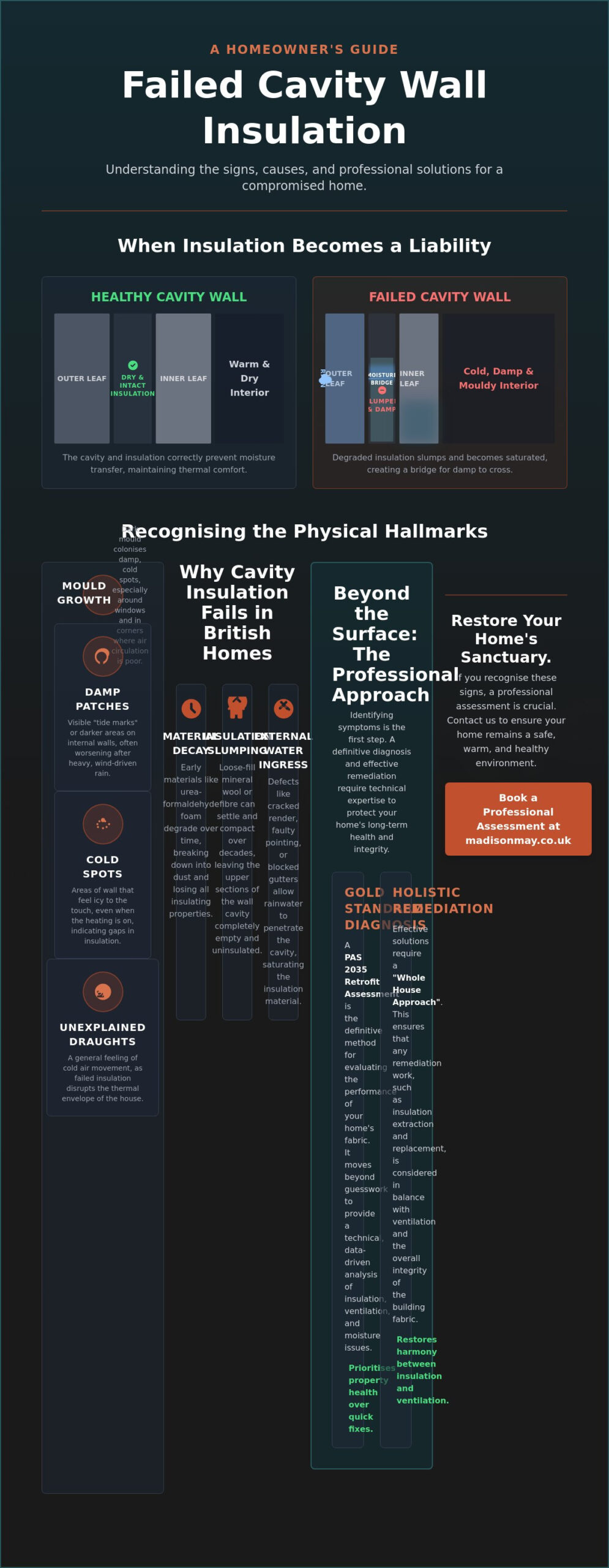
Identifying the specific signs of failed cavity wall insulation requires a discerning eye for detail and a respect for the house’s history. In many properties, particularly those treated during the era of mass-installation in the late 20th century, the issues stem from the natural expiration of the materials used. Early urea-formaldehyde foams can break down into a fine, brittle dust, whilst loose-fill mineral wool may slump toward the base of the wall. This slumping leaves the upper sections of your rooms exposed to the cold, creating uncomfortable temperature gradients that disrupt the harmony of your interior.
Sometimes, the failure isn’t the material itself but an external change that impacts the internal environment. Blocked gutters, damaged pointing, or cracked render can allow water to penetrate the cavity, saturating the insulation and stripping away its thermal properties. To truly understand these complexities, a professional building survey is essential. It provides a meticulous assessment of the fabric, ensuring that any roadmap to restoration is based on technical reality rather than guesswork, allowing you to reclaim your home’s sanctuary with confidence.
Recognising the Physical Hallmarks of Failed Cavity Wall Insulation
Seeing the walls of your home, usually a canvas for personal expression or a backdrop for quiet family life, begin to show the tell-tale marks of decay is deeply unsettling. It’s more than a mere maintenance concern; it’s an intrusion into your sanctuary. When the thermal envelope is compromised, the house begins to communicate its distress through a series of visual and atmospheric cues. Identifying these signs of failed cavity wall insulation early is the first step toward restoring the harmony and health of your living environment.
Visual Indicators: Damp, Mould, and Efflorescence
The most striking evidence often appears as “tide marks” or dark patches on internal plasterwork, which tend to grow more pronounced after periods of heavy, driving rain. These patches frequently manifest in specific areas, such as around window reveals or at the floor-to-wall junction, where insulation may have slumped or was never correctly installed. In these cold spots, moisture from the air condenses, creating the perfect habitat for mould to colonise. You might also notice efflorescence, a white, powdery salt that migrates through the brickwork and plaster. This isn’t just an aesthetic flaw; it’s a sensory reminder that the barrier between your home and the elements has dissolved.
Atmospheric Changes: Cold Spots and Persistent Draughts
The sensation is unmistakable. Even with the heating active, certain walls feel icy to the touch, radiating a chill that makes a room feel uninviting. This occurs because gaps in the insulation create “thermal bridges,” allowing heat to escape and cold to seep in. These voids often trigger convection currents within the room, resulting in persistent draughts that seem to come from nowhere. Whilst these currents are invisible to the naked eye, a professional ventilation assessment or thermal imaging survey can visualise these thermal leaks, providing the empirical data needed to plan a precise restoration.
Structural Red Flags: Cracking and Blistering
When insulation becomes saturated, the consequences can eventually move beyond the surface. Persistent moisture within the cavity can cause wall ties to corrode and expand, which may lead to horizontal cracking in the external masonry. Internally, you might observe wallpaper peeling away from the corners or paint beginning to blister as trapped moisture tries to escape. These structural warnings suggest that the fabric of the building is under significant stress. Addressing these issues often requires specialist damp remediation to ensure the home’s integrity is fully restored before new measures are introduced.
To perform a preliminary walkthrough of your property, consider this checklist of common indicators:
- Persistent mould growth in the corners of rooms or behind large furniture.
- Damp patches that correlate with external weather patterns.
- A noticeable drop in temperature when moving between different areas of the same room.
- Peeling or bubbling decorative finishes on external-facing walls.
- The presence of white, salty deposits on interior walls.
The Silent Culprits: Why Cavity Insulation Fails in British Homes
Whilst the visual cues of a compromised home are often distressing, the underlying causes are frequently silent, cumulative, and deeply rooted in the technical reality of the building’s environment. Understanding why these systems falter is essential for any homeowner seeking to move beyond temporary fixes toward a permanent restoration of their property’s integrity. Often, the very signs of failed cavity wall insulation we observe are the result of a mismatch between the insulation material and the specific environmental stresses the house must endure. It’s a call for a more meticulous, professional oversight that treats the home as a singular, breathing entity rather than a collection of isolated components.
Environmental Stress and Wind-Driven Rain
The British climate remains one of the most significant challenges to the longevity of any building material. In coastal regions or elevated upland areas, the phenomenon of wind-driven rain can be relentless. When external masonry is particularly porous or the mortar pointing has begun to perish, moisture is forced deep into the brickwork. In a healthy cavity, this moisture would evaporate or drain away. However, when the cavity is filled with an unsuitable or ageing material, that moisture is absorbed and held against the inner leaf of the wall. Surveyors often refer to “exposure zones” to determine a property’s suitability for certain treatments; homes in high-exposure areas are frequently at risk if the insulation material stays saturated for extended periods, eventually leading to the failure of the thermal envelope.
The “Insulation without Ventilation” Trap
A home is a living system that requires a delicate equilibrium between heat retention and airflow. A common pitfall in modern property management is the tendency to seal a house too tightly. When we install new windows or doors without considering the impact on the building’s natural respiration, we can inadvertently create a “trap” for internal humidity. If the cavity insulation is already failing or damp, it exacerbates these internal humidity levels, as the walls can no longer “breathe” or manage moisture effectively. This leads to a rapid decline in air quality and the onset of condensation issues that are often mistaken for simple surface damp.
This complexity highlights why successful energy efficient home improvements must always follow a “whole house” philosophy. Rather than viewing insulation in isolation, a sophisticated approach considers how every change, from heating upgrades to draught proofing, interacts with the existing fabric. By addressing the root causes of failure amongst the wall structure, we can ensure that your home remains a true sanctuary, defined by enduring quality and a sense of lasting calm.
Beyond the Surface: The Vital Role of Professional Retrofit Assessments
Identifying the visible signs of failed cavity wall insulation is merely the first chapter in your home’s restoration story. Whilst it’s tempting to seek an immediate remedy from the first contractor who promises a solution, a truly sophisticated approach requires a deeper, more technical investigation. This is where a professional assessment becomes indispensable. By moving beyond surface-level observations, you can gain a holistic, data-driven understanding of your property’s thermal and structural health, ensuring that any subsequent investment is both precise and permanent.
What to Expect During a Retrofit Assessment
A professional assessment is a quiet, methodical process that respects the sanctuary of your home. It begins with a comprehensive inspection of the building fabric, existing insulation layers, and the often-overlooked ventilation systems. Using non-invasive tools, such as thermal imaging and borescope cameras, a qualified assessor can peer into the cavity without disrupting your decor. This allows them to identify hidden moisture, slumped material, or thermal gaps that are invisible to the naked eye. The result is a meticulous report that translates these technical findings into a clear, actionable narrative for your property’s future.
The Independence of the Retrofit Coordinator
One of the most significant advantages of this process is the role of the Retrofit Coordinator, who acts as a dedicated project guardian. Unlike a contractor who may have a vested interest in selling a specific product or service, an independent consultant prioritises the long-term integrity of your home. They ensure you receive a PAS 2035 compliant assessment, which is the current gold standard for domestic energy upgrades in the UK. This rigorous framework prevents the “quick-fix” culture that often leads to repeat failures, saving you from the frustration of costly, incorrect remediation work later on.
Choosing this path provides a sense of calm and certainty. Instead of guessing which measures might work, you receive a tailored EPC improvement plan that serves as a definitive roadmap for your home’s evolution. This strategic document ensures that every upgrade, from insulation removal to heating improvements, works in harmony with the building’s original character. If you are ready to move from uncertainty to a clear diagnosis, arranging a professional retrofit assessment is the most effective way to protect your investment and restore your home’s comfort.
Navigating Remediation: Restoring the Integrity of Your Home’s Fabric
Remediation is a journey of reclaiming your home’s character. Once the signs of failed cavity wall insulation have been identified through a meticulous assessment, the path to restoration begins with clearing the way for the building to breathe once more. This is not a process to be rushed; it requires the calm deliberation of experts who understand the delicate balance between masonry and modern thermal requirements. A “Whole House Approach” ensures that every intervention works in concert, transforming a house plagued by damp into a serene, high-performing sanctuary that reflects your commitment to quality.
For those looking to address comprehensive moisture issues, property preservation specialists such as Smart Property Care Ltd offer expert solutions that protect the building’s fabric while potentially unlocking the value of underutilised spaces.
The Process of Cavity Wall Insulation Removal
Extraction is a precise operation. Professional teams use specialised equipment to vacuum or blow the compromised material from the cavity, clearing the void of saturated mineral wool or brittle foam. Once emptied, the cavity must be allowed to dry out completely. This period of respiration is vital, as introducing new measures too quickly can trap residual moisture. Simultaneously, any perishing mortar or cracked brickwork must be addressed, sealing the external envelope against the future ingress of wind-driven rain whilst maintaining the aesthetic integrity of the facade.
Integrating Ventilation and Fabric Upgrades
A common oversight in property management is the failure to address the “ventilation gap.” When we improve the thermal performance of a wall, we must also ensure the air quality within the home remains pristine. Remediation should be paired with the installation of mechanical ventilation or discreet passive vents to manage internal humidity. This is particularly crucial when upgrading other elements of the fabric. For instance, new windows and doors must be integrated into a wider energy strategy that accounts for the building’s renewed airtightness and ventilation needs.
Restoring your home’s sanctuary is a transformative artistic journey. By choosing a curated, professional approach, you ensure that functionality and beauty remain in effortless union. At Madison May Consulting Ltd, we act as your attentive guide through these complexities, helping you move from the initial spark of inspiration to a finished, healthy environment that resonates on a personal level. We invite you to consult with our team to begin the meticulous process of restoring your home’s thermal integrity and reclaiming your sense of calm.
Reclaiming the Sanctuary of Your Home
Recognising the signs of failed cavity wall insulation is the vital first step in safeguarding the heritage and health of your property. We’ve explored how environmental stresses and ageing materials can compromise your home’s thermal envelope, turning a protective layer into a source of persistent discomfort. By moving beyond surface-level symptoms and embracing a technical, whole-house philosophy, you can ensure that your living space remains the refined refuge it was always intended to be. This journey of restoration is not merely about maintenance; it’s about honouring the identity of your home and its future.
The path forward is most effectively navigated with the guidance of an independent expert who prioritises your property’s unique story. Madison May Consulting Ltd provides meticulous, PAS 2035 aligned assessments and independent expert consultancy, ensuring your restoration is grounded in technical excellence. Through a comprehensive EPC improvement plan, we offer a clear, data-driven roadmap to lasting thermal comfort and air quality. We invite you to book a professional retrofit assessment with Madison May Consulting Ltd to begin this transformative process. Your home is your sanctuary, and with the right care, its sense of calm and quality can be beautifully restored.
Frequently Asked Questions
How do I know for certain if my cavity wall insulation has failed?
You can only be certain by commissioning a technical survey, such as a borescope inspection or thermal imaging. Whilst visual cues are helpful, they only suggest the presence of a problem. A professional assessment provides a definitive diagnosis by looking inside the wall void itself. Identifying the signs of failed cavity wall insulation through these non-invasive tools ensures your restoration plan is based on empirical evidence rather than guesswork.
Can failed cavity wall insulation cause health problems for my family?
It can, as saturated insulation frequently leads to persistent mould growth and poor internal air quality. These conditions can aggravate respiratory sensitivities and affect the general wellbeing of your family. By allowing moisture to linger amongst the wall fabric, failed insulation creates a damp environment that is far from the healthy sanctuary your home was intended to be. Prioritising remediation is essential for restoring a serene living atmosphere.
Is it always necessary to remove failed cavity wall insulation?
It is almost always necessary to remove material that has become saturated, slumped, or degraded. Leaving compromised insulation in place allows it to continue acting as a bridge for moisture to cross the cavity. This persistent dampness erodes the building’s fabric and prevents the walls from performing their original role. Extraction is the only way to clear the void, allowing the structure to breathe and dry out effectively.
How much does a professional retrofit assessment cost compared to a standard survey?
A professional retrofit assessment typically requires a higher investment than a standard survey due to its meticulous depth. Unlike a basic inspection, a PAS 2035 compliant assessment involves a comprehensive evaluation of the building’s fabric, ventilation, and energy performance. This technical rigour provides a definitive roadmap for your home’s evolution, ensuring that any future improvements are perfectly tailored to the unique requirements of your property.
Will removing the insulation make my energy bills go up significantly?
You may notice a slight change, but saturated insulation is already failing to provide a thermal barrier. In many cases, wet insulation actually draws heat out of the house, making the walls feel colder than they would if they were empty. Removing the damp material stops this cooling effect. Once the fabric has dried, your home will be better prepared for high-performance upgrades that deliver genuine, long-term energy savings.
How long does it take for a wall to dry out after insulation is removed?
Drying times vary depending on the level of saturation and the property’s exposure, but it often takes several months for a wall to dry completely. The process is influenced by the British weather and the quality of your home’s internal heating and ventilation. It’s a period that requires patience, as ensuring the masonry is thoroughly dry is a prerequisite for any successful future insulation or decorative work.
Can I install new insulation immediately after the old material is extracted?
You should never install new material immediately after extraction. The cavity must be given sufficient time to dry, and any underlying issues with the external masonry or pointing must be professionally repaired. Re-insulating a damp cavity simply traps moisture against the inner leaf, which will lead to a recurrence of the same problems. A steady, measured approach is the only way to protect your home’s long-term integrity.
What is the “Whole House Approach” and why is it important for my home?
The “Whole House Approach” is a philosophy that treats your property as a single, interconnected system. It ensures that improvements to insulation are always balanced with adequate ventilation and efficient heating. This method is vital because it prevents the unintended consequences, such as condensation or poor air quality, that often occur when energy measures are installed in isolation. It’s the most sophisticated way to create a lasting, comfortable sanctuary.